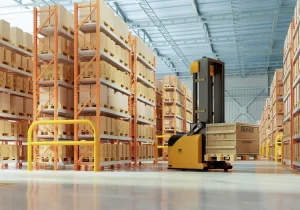
Power quality has become a primary design variable in warehouse automation, where fleets of robots, high-speed conveyors, and dense sensor networks leave little room for electrical instability. As assets grow more autonomous and software-driven, buck-boost converters in warehouse automation now sit at the center of efforts to keep voltage steady, uptime high, and assets productive.
Why Automated Networks Expose Weak Power Architecture
Automated distribution centers behave like large, constantly shifting DC loads. Robots accelerate and brake in bursts, conveyors ramp up and down with order surges, and thousands of scanners, readers, and control units cycle on and off. Battery-powered platforms add more volatility as pack voltage naturally decays over each shift. The result is a power environment where input voltage can sag or spike from second to second, even when the facility connection looks stable on paper.
That volatility translates quickly into operational loss. Sensitive control electronics can reset during dips, field devices can throw communication errors, and misreads at scan tunnels can corrupt routing logic. A single cluster of missed barcodes or dropped messages can push exceptions across hundreds of orders in minutes and pull supervisors into manual recovery work. Industry incident analyses of automated hubs regularly trace unexplained stoppages back to marginal power design rather than software or equipment defects.
Buck-boost converters directly target this instability. They regulate DC output to a fixed setpoint when incoming voltage drifts above or below the required level, using rapid switching elements such as MOSFETs with inductors and capacitors as energy buffers. By continuously adjusting the switching duty cycle, they smooth the chaotic behavior of the upstream bus into a predictable feed for downstream electronics. This capability matters most where load and input both move, such as mixed fleets that draw from shared DC rails or battery systems.
The impact is visible in typical conveyor sortation lines. A central supply might deliver 36 V to multiple branches, while sensing equipment requires 12 V and programmable controllers run at 24 V. When several motors start simultaneously, the shared bus can dip sharply. Unregulated, that dip can cause sensors to misread and controllers to restart mid-cycle. With local buck-boost stages dedicated to each voltage rail, those subsystems continue to see stable power, keeping scan accuracy and sort logic intact even during aggressive ramp-up.
Modern converter modules are engineered for this kind of environment. Many industrial units accept inputs spanning roughly 8–60 V DC and deliver tightly regulated outputs anywhere between typical logic levels and motor drive voltages, often within about one percent of the setpoint. Current ratings extend from low-amperage electronics loads to tens of amps for motion applications. Efficiency figures in the low-to-mid 90 percent range reduce heat generation, easing enclosure design and extending component life.
Protection and diagnostics are now standard features. Overvoltage, undervoltage lockout, overcurrent, thermal shutdown, and short-circuit protection help prevent small wiring or configuration errors from becoming major failures. Housings are typically specified from around -40°C up to about +85°C with vibration robustness and mounting schemes suited to racking, panels, or DIN rail. Increasingly, converters expose digital interfaces such as I2C or PMBus, allowing higher-level systems to read voltage, current, and temperature in real time and adjust settings remotely.
Mobile Robots Show The Cost of Ignoring Voltage Behavior
Autonomous mobile robots in fulfillment and manufacturing facilities illustrate why DC stability is no longer an afterthought. These platforms usually rely on lithium-ion batteries, which may start around 48 V when fully charged and drift down toward 30 V before the robot returns to charge. Onboard systems, however, expect consistent rails for drives and sensing, for example 36 V for traction motors and 12 V for guidance cameras and safety sensors.
If those consumption points tie directly to the battery stack, the electronics face overvoltage at the start of the discharge curve and undervoltage near the end. That creates erratic performance, early shutdowns to protect components, and reduced usable capacity from each charge. Buck-boost converters placed between the pack and each subsystem decouple battery behavior from functional requirements. They hold output rails constant across the entire discharge window, which extends runtime, reduces nuisance trips, and keeps movement predictable until the robot intentionally exits to charge.
Deploying these architectures requires more than selecting catalog parts. Engineers first map load behavior: continuous draws, pulsed loads, and highly dynamic sequences have different sizing implications. Thermal design becomes a central consideration, since compact converters running at efficiencies above 90 percent still dissipate meaningful heat within enclosures already crowded with computing and RF equipment. Electromagnetic interference also needs active management through layout, shielding, and filtering, particularly in dense radio environments where noisy switching supplies can degrade wireless performance.
Risk and continuity planning influence layout as well. High-availability systems such as sortation hubs or AS/RS aisles often require redundant power paths or parallel converters with automatic failover, so that a single module fault does not stop a critical zone. Some operators now integrate converter telemetry into broader control tower dashboards, using real-time voltage and temperature data as early indicators of degradation in batteries, bus bars, or field wiring.
Power Stability As A Hidden Lever of Network Efficiency
Many automation programs still prioritize mechanical throughput, software orchestration, and labor redesign ahead of power integrity, yet experience in highly automated hubs suggests that marginal voltage control quietly erodes all three. Facilities that treat DC stability as part of core network design, supported by industrial-grade buck-boost converters and active monitoring, tend to see smoother ramp-up of new assets, fewer unexplained stoppages, and better return on automation capital. As more sites add AI-driven energy optimization and on-site generation, converters capable of granular control and digital reporting will become key to balancing energy cost, equipment health, and service performance across the wider logistics network.