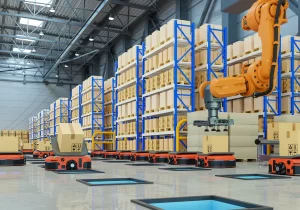
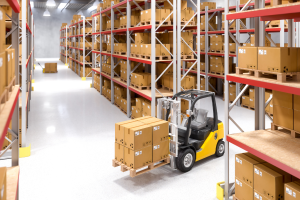
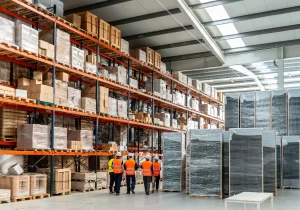
Vision AI warehouse automation is reshaping how existing facilities handle risk, throughput and labor, without waiting for new greenfield builds. As physical automation and AI converge on the warehouse floor, decisions about where and how to deploy these tools now shape service performance, safety exposure and capital efficiency across the entire network.
Vision AI as a Retrofit Lever, Not a New-build Luxury
Most automated systems still assume a perfectly gridded, purpose-built warehouse. Fixed shuttle tracks, cube storage and floor robots depend on layouts that are expensive to construct and slow to change, which turns each footprint decision into a long-term bet on volume, mix and labor economics. Brownfield and smaller sites usually cannot justify that bet, so capacity expansions and service improvements must come from the assets already in place.
Advanced vision AI shifts the constraint. Cameras, edge processors and machine learning models can be layered onto existing racking, conveyors and mobile platforms, so automation can adapt to the building instead of forcing structural redesign. This matters at network scale: the majority of nodes are legacy sites that handle volatile demand, promotional spikes and channel shifts. Vision-enabled automation gives those nodes a way to increase picks per hour, reduce handling errors and manage congestion without sacrificing storage density or shutting down for major reconfiguration.
The same logic already plays out on the road. AI-enabled driver monitoring uses video and behavior data to detect distraction, fatigue and harsh maneuvers, then closes the loop with real-time alerts and coaching. Cameras, ADAS sensors and telematics do not require a new fleet; they retrofit risk intelligence and intervention onto trucks that are already running. Vision AI inside the warehouse does the same for pallets, totes and robots on the floor.
From Hazard Detection To Decision-ready Data Flows
Once installed, vision AI becomes a structural data source, not just a guidance layer for robots. Models can detect hazards such as spills, dropped items and unexpected pedestrians, then route mobile equipment around them and trigger clean-up tasks. That keeps flow running and compresses the time between incident and remediation, which reduces unplanned downtime and secondary safety events.
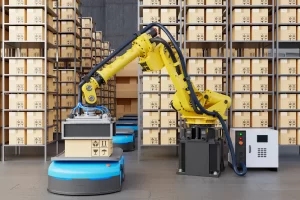
The same stack can read and interpret the physical state of work. Bin-picking systems blend lightweight robotic arms with high-speed image processing to identify the right item, calculate grasp points and execute the move at scale. When a system achieves thousands of picks per hour at very high accuracy, the implications extend beyond a single workstation. Order release logic, dock scheduling and trailer loading can be recalibrated on the assumption that certain pick zones will no longer be the pacing constraint.
Palletization and depalletization are another structural bottleneck. Mixed loads with variable packaging have resisted automation because each layer looks different. Vision AI can segment those loads, set grasp priorities and guide placement in real time, which removes the need for extensive pre-sorting. That changes both labor planning and inbound slotting: fewer touchpoints per pallet, more predictable intake times and a clearer view of when inventory will actually be available to promise.
Telematics offers a useful parallel. On the road, AI-powered cameras trigger event-based clips when distraction coincides with a safety-critical maneuver. That approach reduces data volume while preserving context, and it underpins risk scoring and coaching programs. In the warehouse, the same principle can support continuous performance management: capture only the frames tied to congestion, near-misses or mis-picks, then use them to refine layouts, update standard work and tune AI models.
Designing Automation That Respects Human Limits
Vision AI is physical AI, and that means it changes the experience of work as much as it changes throughput metrics. In cabs, more screens and alerts can overwhelm drivers if not designed and governed carefully. Privacy objections and distrust can stall or derail telematics programs unless communication, policy and governance are clear from the outset. The same human factors apply in the warehouse.
Workers interact with cobots, cameras and digital prompts throughout a shift. Poorly tuned alerts, black-box recommendations and opaque monitoring practices introduce cognitive load and resistance, which undermines adoption and undercuts the business case. Clear intent, strict data minimization and edge processing help. If models can detect risk states without constant video streaming or storage, and if footage is tightly governed for safety and operational use only, automation becomes a support tool rather than a surveillance system.
This is also a skills question. As robots handle more routine lifting, human roles tilt toward exception management, orchestration and cross-functional coordination. That mirrors the shift on the road, where telematics and ADAS push drivers into higher-value tasks like situational judgment and collaborative problem-solving with dispatch. Investing in training around AI interpretation and incident review is no longer optional; it is core to realizing the promised payback windows on automation programs.
Physical AI Expands The Reach Of Existing Networks
The growing role of vision AI suggests that future automation programs will be evaluated across entire distribution networks rather than individual facilities. Retrofitting existing warehouses with sensing, perception and decision capabilities allows organizations to improve throughput and safety while extending the productive life of established assets. As physical AI becomes more widely deployed, warehouse infrastructure, transport operations and planning systems will increasingly rely on the same stream of real-time visual data to coordinate execution across the network.