
Why planning teams need better choices, not just better predictions
The forecast is no longer enough
For years, planning improvement has been measured through forecast accuracy. Better data, better models and better planning discipline were expected to produce a more reliable view of demand, allowing the business to manage inventory, capacity, supply and service with greater confidence.
Forecast accuracy still matters. But it is no longer enough.
The problem is that the forecast is now only one moving part in a much larger decision environment. Demand shifts more quickly. Supply is less reliable. Lead times change without warning. Freight costs move. Customers expect more flexibility. Inventory is more expensive to hold. Capacity choices carry sharper financial consequences. In that environment, a more accurate forecast does not automatically create a better outcome.
The plan breaks when the assumptions move
The central tension is that planning teams are being asked to make better decisions in conditions where the assumptions behind the plan keep changing.
A forecast may be technically strong when it is produced, but still become less useful if supply availability changes, a supplier misses a commitment, a logistics route is disrupted, or a customer shifts demand at short notice. The issue is not simply whether the number was right. It is whether the business can respond intelligently when the number is no longer enough.
This is why planning maturity has to move beyond prediction. The real test is whether the organisation can make better trade offs across service, stock, capacity, cash and margin when reality starts to move away from the plan.
Forecast accuracy can become a narrow goal
Forecast accuracy is attractive because it is measurable. It gives teams a clear target and a sense of progress. But it can also narrow the conversation.
A planning team can improve forecast accuracy and still make poor enterprise decisions. It can optimise the number but miss the cost of holding too much stock. It can protect availability but tie up too much cash. It can chase demand signals but fail to understand capacity constraints. It can improve the planning pack while the business still reacts late. The danger is treating the forecast as the answer, rather than one input into a wider decision system.
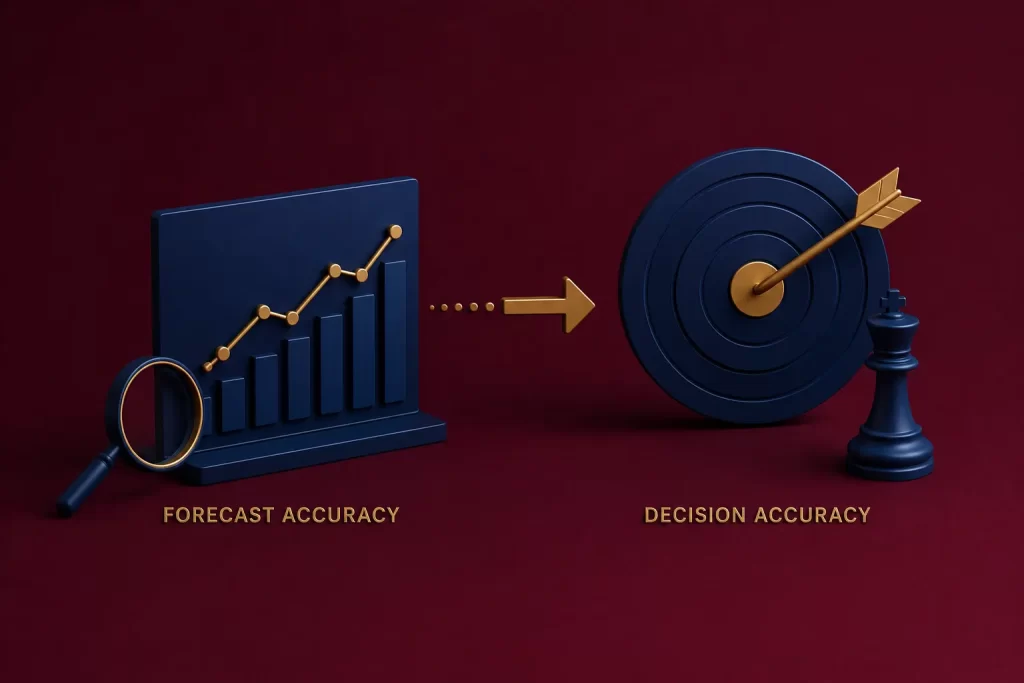
Decision accuracy asks a more useful question. Given what we know now, what is the best decision the business can make, and what trade off are we accepting?
AI changes the planning conversation
AI has the potential to improve forecasting, scenario modelling, exception management and decision support. It can help teams detect patterns earlier, test different outcomes and identify risks that manual planning processes may miss. But AI does not remove the need for judgement. In fact, it increases the need for clearer judgement.
If AI produces a demand signal, the business still needs to decide whether to build inventory, protect capacity, adjust supply, change customer commitments or wait for confirmation. If AI identifies a supply risk, leaders still need to decide whether to expedite, switch suppliers, allocate stock or escalate. If AI models several scenarios, someone still needs to decide which risk the business is willing to carry.
The value is not in a smarter forecast alone. It is in a smarter decision process around the forecast.
Planning needs thresholds, not just cycles
Traditional planning rhythms often rely on fixed cycles. Monthly reviews, weekly updates and periodic reforecasts still have value, but they are too slow when assumptions move quickly.
A more responsive planning model needs clearer thresholds. Which changes are material enough to trigger a new decision? Which exceptions can be handled inside planning? Which require commercial, finance, logistics or executive input? When should the business change course, and when should it hold the plan?
This matters because constant reaction can be just as damaging as slow reaction. The goal is not to respond to every signal. It is to know which signals matter, which decisions they trigger and who owns the trade off.
Decision accuracy is an enterprise capability
Better planning is not only a planning function issue. Demand, supply, inventory, capacity, logistics, finance and customer promise are connected.
If planning teams are expected to improve decisions, they need the authority and cross functional connection to do so. Commercial teams need to understand the operational consequences of demand changes. Finance needs to see the cash and margin impact of service choices. Logistics needs to be part of lead time and availability decisions. Procurement needs to connect supplier risk with planning assumptions.
Decision accuracy improves when the business can bring these perspectives together before the cost of delay increases.
The real test of planning maturity
The future of planning will not be judged only by whether the forecast improves. It will be judged by whether better intelligence leads to better choices.
The opportunity is to move planning from a prediction exercise to a decision discipline. That means using forecasts, AI, scenarios and exceptions to make clearer trade offs across service, stock, cash, capacity and margin.
The real test is not whether the business can predict the future more accurately. It is whether it can make better decisions when the future changes.
As planning evolves from producing better forecasts to enabling better decisions, organisations also need new ways to connect planning, AI, commercial priorities and operational execution. These are among the defining conversations shaping the future of supply chain leadership and will be explored at the SupplyChain360 Summit, where senior executives will examine how planning, decision-making and enterprise collaboration must evolve to succeed in an increasingly volatile business environment.