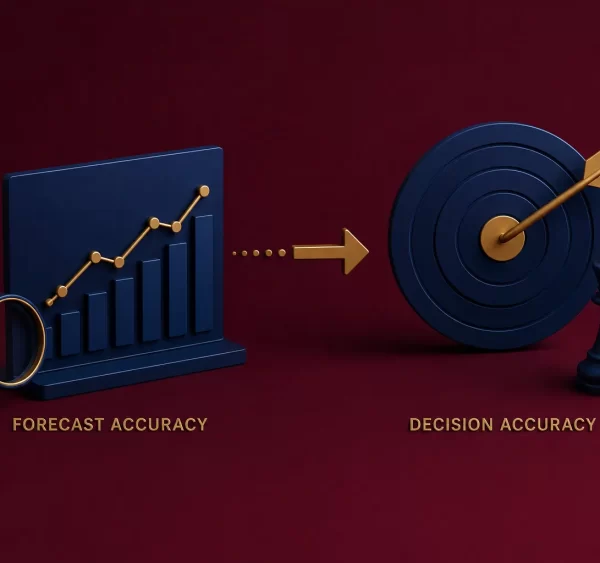

AI can make supply chain analysis faster. It can surface risks, model scenarios and recommend actions at a pace that would have been difficult to imagine only a few years ago. But it cannot create value if the organisation still cannot decide what to do.
That is one of the most important realities behind AI adoption in supply chain. Many companies are investing in tools that promise better visibility, better forecasts and faster recommendations. Yet the decision processes those tools enter are often still slow, manual, functional and unclear.
A system may identify a supply risk, but procurement, quality, legal and operations still need to agree what can be done. A planning tool may recommend a different inventory position, but finance still needs to accept the working capital impact. A logistics platform may flag a service issue, but customer service, commercial teams and operations may not have a shared escalation path.
The issue is not that these controls are unnecessary. In complex supply chains, many of them exist for good reason. The issue is that faster insight does not automatically create faster action.
Supply chain decisions are not single function decisions
The most important supply chain decisions are rarely owned by one function. They sit across planning, procurement, logistics, manufacturing, finance, commercial teams, customer service, suppliers and customers. They are not just operational choices. They are enterprise trade offs.
AI can make those trade offs more visible. It can show possible options, model consequences and recommend a route forward. But it cannot decide who owns the trade off between cost and service, inventory and cash, resilience and efficiency, supplier optionality and complexity, or customer promise and margin. That is where many AI programmes will stall. Not because the model cannot produce an answer, but because the business has not designed the decision process around the answer.
Governance is not the enemy
It is tempting to frame governance as the thing that slows supply chains down, but that is too simplistic. In many supply chains, governance protects the business. Pharma manufacturers need validation. Automotive supply chains need quality control. Food supply chains need safety and compliance. High-value manufacturing environments need traceability. Consumer goods businesses need to protect customer experience, brand trust and commercial relationships.
The answer is not to remove control. The answer is to make decision rights clearer. If AI recommends an action, what happens next? Can it be accepted automatically within agreed thresholds, does it require planner validation, does it need escalation to procurement, finance, quality, logistics or commercial teams, and who remains accountable if the recommendation is wrong? Without that clarity, AI creates another layer of advice that people may not trust or act on.
Supplier switching shows the gap between recommendation and action
Supplier risk is a good example. The technology story can sound simple. A supplier becomes high risk, the system identifies an alternative and the business switches supply.
In reality, supplier changes are rarely that clean. There may be qualification processes, quality checks, regulatory requirements, contractual constraints, capacity limits, technical validation and customer implications. Alternative suppliers are not always waiting with spare capacity. Even known suppliers may need approval, reallocation or commercial negotiation before they can take additional volume.
AI can still help. It can identify risk earlier, model alternative options and compress some of the analysis. It can help teams understand the likely consequences of different choices. But the value is not in pretending the decision process disappears. The value is in knowing which parts can be accelerated, which parts require human judgement, and which controls must remain in place.
Faster scenarios do not help if the business cannot choose
Scenario planning is one of the areas where AI should create real value. Supply chain leaders are dealing with tariff changes, supplier disruption, capacity constraints, freight volatility, shifting demand and inventory risk. The ability to model options quickly is valuable.
But scenario generation is only half the problem. The business still has to choose whether the priority is service, margin, cash or resilience. It has to decide whether some customers are more important to protect than others, whether it is willing to carry more stock, whether the cost of optionality is justified before disruption hits, and who decides when there is no perfect answer. If those questions are unresolved, AI simply gives faster options to a business that is still unable to make the trade off.
The real work is decision architecture
The practical starting point is not a long list of AI use cases. It is a map of the decisions that are currently too slow, too manual, too siloed or too expensive when wrong. Where does the business lose time? Where does escalation happen too late? Where do functions disagree on the trade off? Where do teams rely on spreadsheets, meetings or individual experience? Where does the cost of delay show up in service, working capital, margin or customer trust?
Those are the places where AI may have value. Not because the technology is impressive, but because the decision already matters.
Once the decision is clear, the technology conversation becomes more useful. Leaders can define what data is needed, what recommendation would improve the outcome, what level of automation is acceptable, where validation is required and who remains accountable. That is decision architecture. It is the connection between data, workflow, ownership, thresholds, escalation and action.
AI will expose weak decision processes
AI will not transform supply chain by sitting on top of the same slow processes and hoping the business moves faster. It will expose where decisions already get stuck. It will expose unclear ownership, weak escalation paths, functional silos, poor trust in data and systems, and the gap between insight and action.
That is not a reason to avoid AI. It is the reason to approach it differently. The supply chain teams that benefit most will not be the ones with the longest list of pilots. They will be the ones that understand which decisions need to change, what level of human control is still required, and how accountability works when recommendations become actions.
AI can accelerate analysis. It can improve recommendations. It can help teams see patterns, test options and respond earlier. But the organisation still has to be able to decide.
At the SupplyChain360 Summit, we will be exploring this directly in a session titled When AI Starts Taking Action. The session will examine where autonomous workflows can help, where human judgement must remain in control, and how supply chain leaders define the decision rights, guardrails and accountability needed for AI-enabled operations.
Join us at The Belfry, Sutton Coldfield, on 3–4 March 2027 to be part of the discussion and hear practical insights from senior supply chain leaders shaping the next operating model for enterprise supply chains.