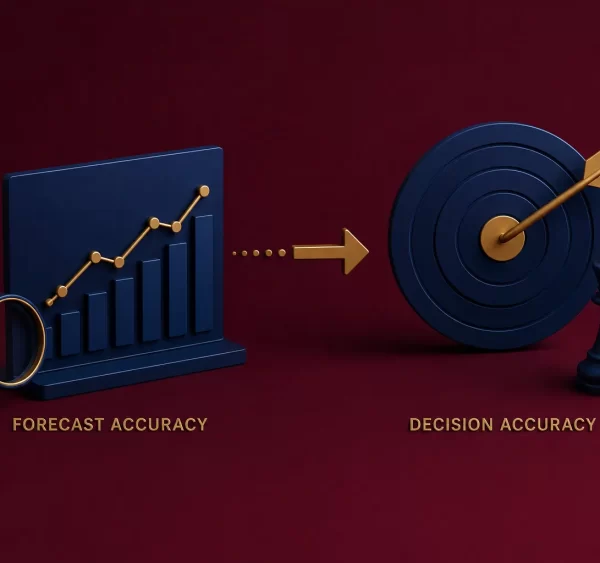

AI is moving quickly from analysis to recommendation. In supply chain, that shift matters. A tool that summarises information or highlights a risk is one thing. A system that recommends a change to the plan, triggers an exception workflow, reallocates inventory, proposes an alternative supplier or suggests a customer response is something else entirely.
The question for supply chain leaders is no longer only what AI can do. It is what AI should be allowed to do, where humans still need to intervene, and who remains accountable when a recommendation becomes an operational action.
That question is becoming more urgent because supply chain decisions are rarely clean. They involve uncertainty, incomplete data, customer impact, financial consequences, operational risk and trade offs between functions. AI can help teams move faster, but speed is not the same as judgement.
AI as an assistant is easier to accept
Most organisations are already finding practical uses for AI as an assistant. It can summarise documents, analyse data, draft scenarios, support exception reviews, identify patterns or reduce manual work. These uses improve productivity without fundamentally changing who owns the decision.
That is why adoption often starts here. The risk feels lower, the output can be reviewed, and the human remains clearly in control. The harder question comes when AI begins to shape the workflow itself. If a system recommends a replenishment change, a supplier action, a logistics escalation or a planning adjustment, the organisation needs more than enthusiasm. It needs clear rules for when the recommendation can be trusted, when it needs validation and when it should be blocked.
Not every decision should be treated the same
Supply chain leaders need to avoid two extremes. One extreme is assuming AI should remain permanently limited to low-risk administrative tasks. That would underuse the technology and keep teams trapped in manual workarounds.
The other extreme is assuming that because AI can recommend or automate an action, the business should allow it to do so. The more practical approach is to classify decisions by risk, reversibility and business impact. Some decisions may be suitable for automation within clear thresholds. Some may be suitable for AI recommendation with human approval. Some should be escalated because they affect service, margin, compliance, supplier relationships or customer commitments. Some should remain firmly human-owned. This is not a theoretical exercise. It determines whether AI becomes a trusted operating capability or another tool that teams work around.
Human judgement carries the context the system may not see
Supply chain decisions often depend on context that is difficult to capture fully in a model. A customer may be strategically important beyond the value of the current order. A supplier may be under pressure but still critical to a future product launch. A logistics decision may protect service but damage margin. A planning recommendation may be mathematically sound but commercially wrong because a campaign, launch or customer negotiation has not been reflected in the data.
AI can surface options and consequences, but human judgement is still needed where the decision depends on commercial context, customer relationships, risk appetite or organisational priorities.
That does not make AI less useful. It makes the role of the human more important. The planner, operator or supply chain leader is no longer simply producing the analysis. They are validating the recommendation, adding context and deciding whether the action fits the business reality.
Trust has to be designed into the workflow
Trust in AI will not come from asking teams to believe the technology is clever. It will come from showing how the recommendation was generated, what assumptions sit behind it, what data was used, where the limits are and what happens if the recommendation is wrong.
Supply chain teams are right to be cautious. They have lived with systems that do not reflect operational reality. They know where master data is unreliable, where local workarounds exist and where the official process differs from what actually happens on the ground.
That is why AI adoption needs validation points, escalation rules and feedback loops. Teams need to see when the system is right, when it is wrong, and how human input improves future recommendations.
Without that, people will continue to rely on spreadsheets, local knowledge and manual checks because they feel safer.
Accountability cannot disappear into the system
As AI becomes more embedded, accountability becomes more important, not less. If an AI workflow recommends moving stock, delaying an order, changing a supplier allocation or prioritising one customer over another, someone still owns the consequence. The business cannot allow accountability to dissolve into “the system recommended it”.
That means leaders need to define decision rights before scaling AI-enabled workflows. Who can approve automated actions? Who validates exceptions? Who has authority to override the recommendation? What thresholds trigger escalation? What decisions require finance, quality, procurement, logistics or commercial input? These questions may sound operational, but they are strategic. They determine whether AI can be used safely at scale.
The human role will change, not disappear
The better question is not whether AI will replace supply chain teams. It is how the work changes when AI takes on more of the analysis, pattern recognition and recommendation layer. In many cases, the human role moves up the value chain. Less time spent reconciling data, rebuilding scenarios or manually identifying exceptions. More time spent interpreting trade offs, challenging assumptions, making judgement calls and aligning stakeholders around action.
That shift requires different skills. Supply chain teams will need stronger data literacy, systems thinking, commercial judgement and confidence in working with AI-enabled recommendations. Leaders will also need to help teams adapt without creating fear that the technology is simply there to remove roles. The goal should be clearer work, not just fewer people.
Leaders need a decision map
A practical starting point is to map supply chain decisions into four categories.
- First, decisions that can be automated because they are low risk, repeatable and bounded by clear rules.
- Second, decisions where AI can recommend but a human should approve.
- Third, decisions that should be escalated because they involve significant trade offs, exceptions or cross-functional consequences.
- Fourth, decisions that should remain human-owned because they depend on judgement, relationships, risk appetite or accountability that the organisation is not willing to delegate.
This gives teams a more usable framework than a broad debate about AI adoption. It also creates a clearer conversation between supply chain, IT, finance, legal, quality and commercial leaders. The issue is not whether the organisation trusts AI in general. The issue is which decisions it trusts AI to support, under what conditions, and with what controls.
The real question is control
AI will become more capable. Recommendations will become more sophisticated. Workflows will become more automated. But supply chain leaders cannot allow capability to outrun accountability. The future supply chain will need both speed and control. It will need automation where the decision is repeatable, augmentation where judgement still matters, and clear escalation where the business risk is too high for autonomy. That is why the most important AI question may be a human one.
What should people still own?
At the SupplyChain360 Summit, we will be exploring this directly in a session titled What Should Humans Still Own?
The session will examine how supply chain leaders define judgement, accountability and decision rights as AI enters planning, procurement, logistics, customer service and execution workflows.
Join us at The Belfry, Sutton Coldfield, on 3–4 March 2027 to be part of the discussion and hear practical insights from senior supply chain leaders shaping the next operating model for enterprise supply chains.