Why the next operating model has to be designed around flow, not functions
The end-to-end promise is still unfinished
Most organisations now talk about the supply chain as an end-to-end system. They measure service, cost, inventory, working capital and customer outcomes across the full chain. They ask supply chain leaders to protect growth, manage risk, release cash and improve margin.
Yet many businesses are still managed through functional boundaries. Planning owns the plan. Procurement owns the supplier. Logistics owns movement. Manufacturing owns capacity. Commercial owns the promise. Finance owns the number. Customer service owns the apology when the system fails.
The language is end to end, but the operating model often is not.
The real trade offs do not respect functions
The problem is not that functions are unimportant. They hold expertise, accountability and operational control. The problem is that the most important supply chain decisions cut across them.
A lower purchase price can create longer lead times, higher inventory and weaker resilience. A commercial service promise can create fulfilment complexity and logistics cost. A planning decision can protect availability but tie up cash. A transport decision can protect the customer while damaging margin. A network decision can improve efficiency but reduce flexibility when disruption arrives.
These are not functional decisions. They are enterprise trade offs.
That is the central tension. Supply chains are judged by flow, but many organisations still make decisions in fragments.
Coordination is not the same as ownership
Many businesses try to solve this problem through meetings. Cross functional forums, escalation calls, steering groups and planning reviews all help connect the organisation. But coordination is not the same as ownership.
If the operating model still rewards each function for its own metric, the business will continue to optimise in pieces. Procurement will chase savings. Logistics will chase cost per movement. Planning will chase forecast or availability targets. Finance will chase working capital. Commercial will chase revenue. Each function may perform well, while the end-to-end system underperforms.
This is why supply chain redesign has to go beyond process mapping. The harder work is deciding who owns the trade offs, which metrics matter most and how decisions should be made when service, cost, resilience, cash and customer promise pull in different directions.
Flow has to include material, information and money
Designing around flow means looking at more than physical movement. Material flow matters, but it is only one part of the system.
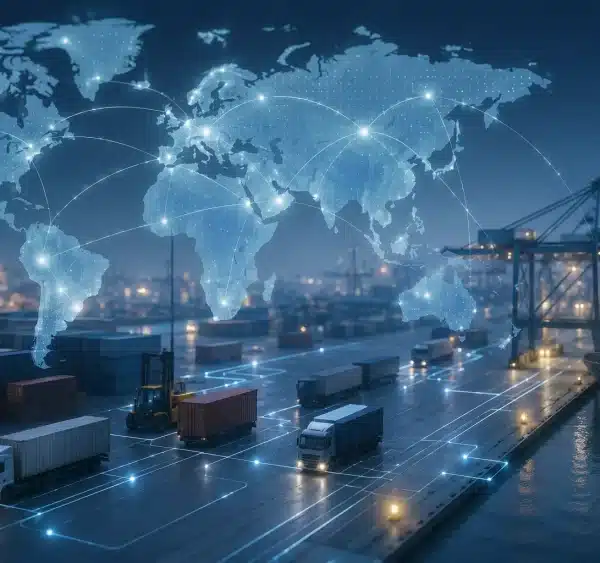
Information flow determines how quickly the business can see demand changes, supply constraints, inventory risk and customer impact. Financial flow determines whether decisions are understood in terms of margin, cash, cost to serve and value protection. Decision flow determines whether insight turns into action fast enough to matter.
When these flows are disconnected, the business reacts late. It finds the stock issue after the customer promise has been made. It sees the logistics cost after the service failure has already happened. It understands the working capital impact after inventory has been built. It discovers the supplier exposure after disruption has arrived.
A flow-based operating model makes those connections visible earlier.
The leadership question is who decides
The shift from functions to flow requires clearer decision rights.
Who decides when resilience is worth the cost? Who decides whether customer service should override margin protection? Who decides whether a supplier saving is worth the additional inventory risk? Who decides when logistics should expedite, hold, reroute or escalate? Who decides when the plan should change because the assumptions behind it no longer hold?
Without clear ownership, these choices move slowly through the organisation. They become negotiations, escalations or workarounds. The supply chain keeps moving, but not necessarily in the direction the business needs.
The new model is not functionless
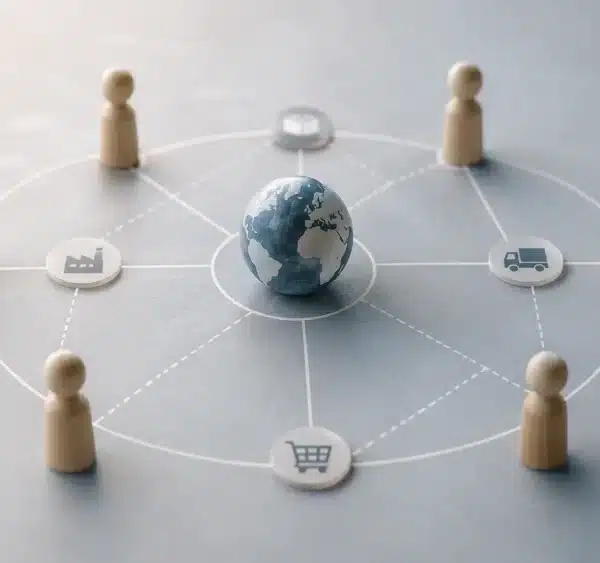
Designing around flow does not mean removing functions. It means connecting them through shared accountability for enterprise outcomes.
The strongest supply chains will still need deep expertise in planning, procurement, logistics, manufacturing, customer service and finance. But that expertise has to be organised around the performance of the whole system, not only the performance of each part.
That means shared metrics. It means decision forums with authority, not just updates. It means incentives that reflect end-to-end outcomes. It means leaders who can understand material, information and financial consequences together. It means treating supply chain as the operating system through which strategy becomes deliverable.
The real test of end-to-end supply chain
The test is not whether an organisation can describe its supply chain end to end. The test is whether it can make decisions end to end.
The opportunity is to move from functional coordination to enterprise flow. That requires a clearer operating model, stronger decision rights and metrics that expose the real trade offs behind performance.
The evolution of the end-to-end supply chain is ultimately about more than improving functional coordination, it is about designing operating models that enable better enterprise decisions. This is one of the central themes of the SupplyChain360 Summit, taking place at The Belfry, Sutton Coldfield, on 3 and 4 March 2027. Through keynotes, case studies, workshops, roundtables and curated 1-to-1 meetings, senior supply chain, procurement and operations leaders will explore how organisations can break down functional silos, strengthen end-to-end decision-making and build operating models that improve flow across material, information and financial networks.
The future supply chain will not be defined by how efficiently each function performs in isolation. It will be defined by how well the business connects material, information and money into decisions that protect service, margin, resilience and customer trust.