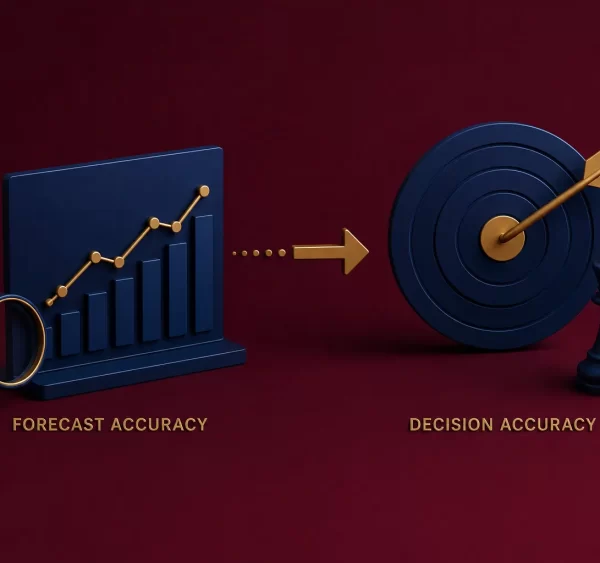

Why the future supply chain will be shaped as much by judgement as by technology
AI is not the hard part
AI is creating a new possibility for supply chain leaders. Decisions can become faster, better informed and more responsive to changing conditions. Planning teams can sense demand shifts earlier. Logistics teams can respond to disruption faster.
Procurement teams can identify supplier risk sooner. Leaders can model trade offs before committing capital, inventory or capacity.
But the opportunity comes with a problem. Most supply chains were not designed for AI enabled decision making. They were designed around functional ownership, manual analysis, monthly planning cycles, escalation meetings, local expertise and spreadsheets that give teams a sense of control when systems do not.
Supply chains are still built for slower decisions
AI can accelerate supply chain decisions, but only if the human operating model is ready to absorb that speed.
The limiting factor is no longer only data or technology. It is trust, judgement, accountability and behaviour. A recommendation is only useful if people understand it, trust it enough to act, know who owns the decision and can explain the trade off when it affects service, cost, inventory, capacity or customer commitment.
This matters because supply chain decisions are rarely clean technical choices. They involve judgement under uncertainty. A forecast change affects production, inventory and customer service. A supplier risk alert may trigger cost increases or sourcing disruption. A logistics reroute may protect service but damage margin. An inventory recommendation may release cash while increasing availability risk.
AI can improve the quality of these decisions, but it cannot remove the need for ownership. In many cases, it makes ownership more important.
Faster intelligence needs clearer ownership
Leaders need to define where AI should automate, recommend or escalate. Not every decision should be treated the same. Some workflows may be suitable for automation because they are repeatable, low risk and reversible. Others should remain recommendation led, with human validation before action. The highest risk decisions, especially those affecting customers, suppliers, margin, compliance or resilience, need clear escalation paths and visible accountability.
They also need to redesign decision rights. If AI recommends a change to inventory policy, who approves it? If it flags a supplier issue, who decides whether to switch, hold or escalate? If it proposes a logistics alternative, who balances cost against customer impact? Without clear decision rights, AI risks becoming another source of noise. More alerts, more dashboards, more recommendations and no faster action.
Judgement becomes more valuable, not less
The future supply chain professional will not simply need better data skills. They will need stronger systems thinking, commercial judgement and confidence working with AI generated options. They will need to understand when to trust the recommendation, when to challenge it and when to bring wider context that the model may not fully capture.
This is where many AI programmes will succeed or fail. If AI is treated as a technology roll out, organisations may create pilots, dashboards and isolated productivity gains. If it is treated as an operating model shift, it can change how supply chains sense, decide, act and learn.
The prize is better control, not less human involvement
The real prize is not removing humans from the loop. It is moving people to a higher value role in the loop. Less time gathering information, more time interpreting trade offs. Less time reconciling spreadsheets, more time governing decisions. Less time reacting late, more time shaping options earlier.
The real test of AI maturity
The competitive advantage will not come from putting AI into supply chain workflows. It will come from redesigning the human workflow around AI, so that people, systems and functions can make better decisions at greater speed without losing judgement, accountability or control.
Technology is only one part of the transformation. The harder challenge is designing an operating model where people, AI, governance and accountability work together at enterprise scale. That is precisely the discussion the SupplyChain360 Summit has been built to enable. Taking place at The Belfry, Sutton Coldfield, on 3–4 March 2027, the Summit will bring together senior supply chain leaders from leading UK and European multinational organisations to explore what the next operating model for enterprise supply chains needs to look like in practice.
The priority is not simply AI adoption. It is building the operating model that allows AI to improve decisions the business can trust, fund and act on.