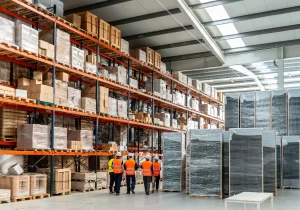
Warehouse productivity is often constrained less by labor availability than by how work moves through the facility. Lean mobility strategies that bring power, data and labeling directly to the point of activity are helping operators cut wasted motion, accelerate throughput and improve inventory accuracy without expanding headcount.
Mobility Waste: The Hidden Constraint In Busy Warehouses
Most warehouses still rely on fixed workstations for receiving, labeling, and data entry, which forces workers to walk back and forth between docks, printers, and terminals. Industry analyses show that non-value-added walking can consume a significant share of shift time in high-volume facilities, directly eroding labor productivity and service reliability. That walking time usually sits alongside other forms of waste: waiting for system access, queuing for shared equipment, re-handling cartons because labels or documentation are missing, and chasing information scattered across paper and screens.
Lean thinking treats these motions and delays as structural design issues rather than worker performance problems. The core question is how to keep people as close as possible to the physical work while giving them everything they need to execute tasks correctly the first time. Mobile powered workstations respond to that challenge by putting power, labeling, and connectivity on wheels, so receiving and put-away activities occur at the point of activity instead of at a central desk. Workers can scan, label, and verify items directly at the trailer or staging area, which reduces touches, shortens dock-to-stock time, and cuts the risk of misrouted inventory.
When combined with basic Lean methods such as standardized work, 5S organization, and visual management, these mobile setups convert walking time into processing time. Simple changes like fixed scan sequences, defined label locations on cartons, and clear exception paths reduce decision-making friction and rework. Industry reports indicate that facilities adopting this approach often unlock measurable gains in lines processed per hour and reduce overtime tied to peak receipts. Even in smaller sites, reclaiming 20 to 30 minutes of productive time per worker per shift compounds into substantial annual savings.
Designing Mobile Workflows For Measurable Throughput Gains
Warehouse teams that treat mobile power as an isolated tool rarely capture its full benefit. The larger opportunity sits in redesigning end-to-end workflows so that information, materials, and people move in sync. That redesign typically starts in receiving, where mobile workstations support live verification against purchase orders, immediate labeling with system-driven data, and instant capture of discrepancies for supplier feedback. Inventory moves from dock to storage locations with accurate identifiers already applied, which stabilizes downstream picking and replenishment.
Similar principles apply in put-away and cycle counting. A mobile cart equipped with a terminal, scanner, and printer allows a worker to confirm locations, print replacement labels on the spot, and correct records without returning to a fixed desk. This reduces data lags and narrows the gap between physical reality and system inventory, which strengthens planning and allocation decisions across the network. Real-time updates also support more precise working capital management: inventory accuracy improves, safety stock assumptions can be revisited, and capital is less likely to be tied up in misplaced or slow-moving items.
Mobility tools work best when supported by clear metrics and governance. Throughput per labor hour, travel distance per transaction, and dock-to-stock cycle time provide direct feedback on whether workflow changes are delivering the expected gains. Facilities that publish these measures at shift level and involve front-line teams in problem-solving tend to sustain improvements longer. Recent trade data and case examples point to additional advantages such as fewer damaged goods from unnecessary re-handling, smoother carrier turn times at the dock, and more stable service to internal manufacturing or external customers.
The Next Productivity Gains May Come From Distance, Not Automation
Many warehouses continue to focus on labor rates, automation investments and system upgrades while overlooking the cost of movement inside the four walls. As fulfillment networks handle more SKUs, channels and service commitments, reducing the distance between workers, information and inventory can unlock capacity that already exists. The facilities that consistently improve performance are often those that redesign work around flow, ensuring that every step, scan and decision happens as close as possible to the task itself.