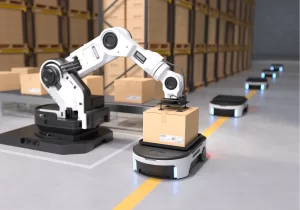
Automation investment is increasingly being judged by what happens when labor is scarce, demand changes quickly or logistics networks come under pressure. The latest State of Logistics report puts the focus on how technology, asset productivity and better information can help companies respond without relying on additional physical capacity.
Warehouse automation has long been associated with productivity and labor savings. That calculation is becoming broader as companies contend with labor constraints, uneven demand, changing trade flows and pressure to extract more from existing logistics assets.
The 2026 State of Logistics report, produced by the Council of Supply Chain Management Professionals and Kearney and presented by Penske Logistics, argues that automation and artificial intelligence are becoming part of a wider effort to build more adaptable logistics networks.
The economic backdrop reinforces that need. U.S. business logistics costs totaled $2.4 trillion, equivalent to 7.8% of GDP, according to the report. That compares with $2.6 trillion and 8.7% of GDP in 2025.
Lower logistics costs do not remove the underlying sources of uncertainty. The report identifies five structural forces affecting the sector, including uneven global growth, tighter financial conditions, trade realignment, labor and productivity constraints, and volatile energy prices.
Automation Has to Solve a Specific Constraint
The case for automation depends increasingly on where it removes a constraint rather than how much technology a company can deploy.
Labor is one of the clearest examples. Persistent workforce constraints are encouraging companies to increase investment in automation and digital systems, particularly where technology can reduce dependence on difficult-to-fill roles or improve the productivity of existing employees.
But resilience requires more than installing automated equipment. Different technologies address different bottlenecks, and their value depends on how effectively they work with inventory systems, transportation networks, labor and other parts of the operation.
That makes orchestration important. An automated warehouse can process goods faster, but that additional capacity has limited value if inbound inventory is delayed, transportation capacity is unavailable or demand signals reach the facility too slowly.
The report therefore emphasizes asset productivity rather than simply expanding the physical footprint. That changes the investment calculation. Instead of adding facilities or capacity whenever constraints appear, companies can examine whether automation, better utilization or faster information flows can increase what existing assets can handle.
AI Extends Automation Into Decisions
Artificial intelligence adds another layer by influencing how decisions are made around those assets.
The report identifies four areas where AI can create supply chain value: interpreting information, predicting outcomes, recommending actions and executing decisions. Those capabilities can support activities ranging from forecasting and inventory management to transportation planning and exception handling.
Adoption, however, remains uneven. Some shippers and logistics providers have embedded AI into core workflows, while others continue to use isolated applications or have yet to deploy the technology meaningfully.
That gap matters because isolated automation can improve individual tasks without necessarily improving the performance of the wider network. A faster decision in one part of the supply chain can simply move a constraint elsewhere if inventory, transportation and fulfillment decisions remain disconnected.
The report consequently places end-to-end visibility and intelligence alongside automation investment. Faster execution becomes more useful when companies can identify where conditions are changing and direct capacity accordingly.
Resilience Will Be Tested by How Fast Capacity Can Adapt
The next test for automation may be less about replacing labor than changing how quickly existing capacity can respond when assumptions fail.
Companies that automate highly predictable volumes can generate efficiency gains, but volatility creates a harder requirement. Equipment, software and workflows must still accommodate changes in product mix, order patterns and network priorities.
That puts greater weight on flexibility when capital is approved. The strongest automation investments may not simply produce the lowest unit cost under normal conditions. They may be the ones that allow existing assets, labor and inventory to be redeployed faster when demand or supply conditions change.