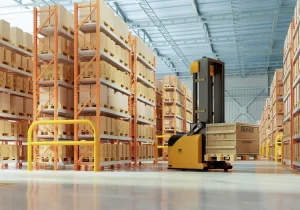
Automated storage and retrieval systems are moving from niche installations to core warehouse infrastructure as robotics and software maturity converge. Recent deployments in Europe and the United States show how dense, robotic storage is reshaping space use, throughput, and labor in complex operations.
From Fixed Racking To Dense, Integrated Storage Grids
Market forecasts from Grandview Research point to a global automated storage and retrieval systems market of roughly $10.3 billion by 2030, growing around 8% a year as operators look for ways to handle more volume in the same or smaller footprint. Shuttle-based systems and cube-based storage platforms are expanding fastest, supported by wider adoption of autonomous mobile robots that can move containers between storage, picking, and production.
A recent expansion at an industrial sensor plant in Kunsziget, Hungary, illustrates how that shift changes the physical and digital layout of a site. The manufacturer extended its factory with three new buildings dedicated to inbound receipts, additional production space, and a compact warehouse for small parts. Logistics automation provider Knapp then overlaid a tightly connected design that links goods-in, storage, picking, and production through a single enterprise warehouse management platform.
At the center sits an automated small-parts warehouse with 52,000 container locations spread across four aisles and 28 levels, serviced by stacker cranes that place and retrieve raw materials and semifinished goods. Containers in three standardized sizes can be stored double- and quadruple-deep, pushing storage density far beyond what manual racking would allow. Two ergonomic goods-to-person workstations handle about half of all items, with digital instructions guiding operators through picks and returns.
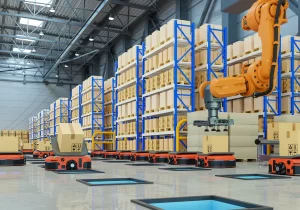
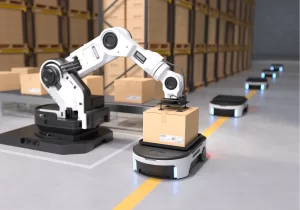
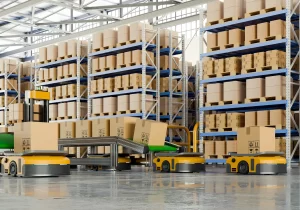
The remaining volume bypasses manual handling entirely. A fleet of 27 open-shuttle autonomous mobile robots shuttles containers between the automated warehouse and four production areas, collecting loads from spur conveyors and feeding flow racks on the line. An overhead conveyor links inbound reception with the small-parts store, with weight checks and registration into the warehouse management system happening at pack stations. Finished products are consolidated on pallets, moved by tugger trains to the outbound zone, wrapped, documented, and dispatched to downstream facilities.
The outcome is a more compact and expandable logistics core. Storage that once spilled into production halls now sits in a high-density structure with clear paths for future growth, including additional storage locations or extra shuttles as volumes rise. Local management has already flagged the design as a foundation for new manufacturing halls now in planning, treating automation as a scalable platform rather than a single-use project.
High-density Robotics as a Network Design Lever
The same logic plays out in a different context at a new central distribution center in Las Vegas, where electrical distributor Sonepar consolidated three branches under one roof. Space pressure in an urban market, combined with high walk-in traffic and regional bulk shipping, pushed the company to look for a storage method that could compress inventory while improving service speed.
Working with automation specialist Kardex, the site deployed an AutoStore cube-based storage grid managed by Kardex FulfillX warehouse execution software and integrated to the enterprise resource planning stack. Around 10,000 stock-keeping units sit in a 5,500-square-foot grid, reducing the required floor area for those items by about 80 percent. Twenty-five AutoStore R5 robots move totes to six picking ports and two inbound stations, supporting both replenishment and order fulfillment without long travel paths for staff.
Performance gains were immediate. Standard order processing rose by roughly 12 percent, while walk-in or will-call orders improved by around 20 percent, helped by shorter distances, directed picking, and higher accuracy. The compact grid cuts internal travel time, lowers building and energy costs, and gives operators rapid access to every stored item without wide aisles or dispersed shelving.
This type of modular architecture also gives network planners more options in capital-intensive locations. Additional robots and ports can be added as order volumes and assortment complexity grow, supporting a decade-long outlook without a new building. Industry data from other high-density projects shows similar patterns: tighter storage grids allow operators to remain in constrained or premium sites, delay greenfield builds, and reconfigure networks around fewer but more capable nodes.
Designing For Orchestration, Not Just Automation
Both projects point to a strategic pivot that goes beyond installing new machines. Automated storage and retrieval systems that combine dense mechanics, mobile robotics, and integrated software become orchestration hubs for production and distribution, not simply replacements for pallet racking. As more operations connect these hubs to control towers, predictive analytics, and dynamic labor planning, the next constraint will be less about technology availability and more about integration discipline and change-ready workforce models that can exploit these assets at full speed.