Robotic grasping is emerging as one of the biggest barriers to broader warehouse automation, with irregular packaging and mixed-SKU inventory continuing to challenge autonomous systems. Advances in adaptive grippers, AI vision and mobile manipulation are expanding the range of tasks robots can perform reliably at scale.
The New Fulfillment Bottleneck: Touching Real Inventory
Most robotic deployments inside warehouses already navigate well, follow optimized routes, and integrate with orchestration software, but they often stall at the point where a machine needs to touch an item. A human picker can adjust grip, angle, and pressure in fractions of a second as polybags cling, cartons deform, or labels obscure surfaces. A robot must interpret that same variability through sensors and algorithms while hitting production-level cycle times.
Robotic grasping in warehouse automation means more than locating and lifting an object. A system has to recognize the item, select a viable contact area, apply appropriate force, maintain control during motion, and place with accuracy, all while inventory shifts in crowded totes or on moving conveyors. Reference deployments of dynamic picking robots in bin picking and induction show how 3D vision and AI-based recognition improve reliability across disordered or misaligned items, yet the range of packaging types and surface conditions in live operations still exposes gaps.
Those gaps become material at scale. A robot that fails on a small percentage of attempts can generate thousands of manual exception events per day when order volumes are high. Exceptions demand human intervention, interrupt flow, and undercut throughput gains that justified automation investment in the first place. Industry reports consistently highlight the long tail of low-frequency, hard-to-handle SKUs as a primary barrier to fully autonomous picking.
Traditional suction-based grippers struggle most in this long tail. They depend on stable, relatively flat, and nonporous surfaces to maintain a seal. Modern fulfillment networks handle porous textiles, perforated polybags, uneven bundles, delicate merchandise, and reflective or wrinkled packaging. Small changes in orientation, humidity, or material stiffness can break suction, even when the robot has navigated accurately to the target. That is why recent innovation has shifted toward adaptive gripping surfaces and combined sensing strategies instead of single-mode suction.
Vendors now pair advanced grippers with high-speed vision, machine learning, and real-time motion planning to support tasks such as dynamic conveyor induction, sorter loading, and mixed-SKU bin picking. Systems like Körber’s VarioPick use AI to identify optimal grip points, synchronize movement with conveyor speed, and remove non-compliant items before they cause downstream jams. The shared objective across these solutions is consistent execution over millions of variable picks, not performance under ideal, lab-style conditions.
Mobile Manipulation: From Moving Work To Doing Work
Labor instability adds urgency to closing the grasping gap. Trade data from U.S. logistics and warehousing continues to show hundreds of thousands of open roles and turnover rates near or above 40 percent annually, even as parcel and e-commerce volumes climb. Fixed automation can ease some of that pressure, but operations with volatile demand profiles and complex SKU ranges need systems that can move to the work and execute tasks independently.
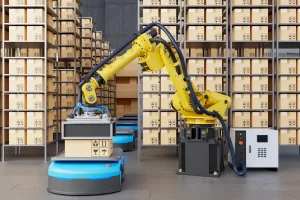
Mobile manipulation addresses that requirement by combining autonomous mobility with sophisticated grasping and handling. A mobile robot that can navigate to a pick face, select from a crowded tote, induct cartons onto a sorter, or transfer items between conveyors shifts automation from simple transport into direct task execution. That shift allows automation to absorb work that currently depends on scarce human labor, particularly during peak periods when temporary staff are hardest to secure and train.
Recent acquisitions and product launches in the sector underscore how critical end-effector technology has become. One prominent example is the integration of patented membrane-based grippers designed to conform to porous fabrics, loosely bagged items, perforated plastics, and other problematic packaging types. By combining flexible contact surfaces with computer vision and onboard sensing, these systems adapt grasp strategy to real-time conditions rather than relying on a fixed seal or predefined pose.
Industry solutions for bin picking, sorting, and induction illustrate a converging pattern. AI-based vision locates items in unstructured environments, adaptive grippers secure them despite irregular shapes, and orchestration software synchronizes robot motion with conveyor timing or upstream workflows. Exceptions are automatically detected and diverted instead of silently failing at the point of pick, protecting overall system availability.
Mobile manipulation also changes how automation is deployed over time. When robots can both travel and manipulate, operators gain a modular way to extend automation across additional tasks without fully redesigning physical infrastructure. Automation can start with high-volume, relatively simple applications like induction loading and then expand toward mixed-SKU tote picking or returns handling as grasping performance improves.
Grasping Performance Will Shape Automation Economics
As warehouse inventories become more diverse and fulfillment expectations continue to rise, robotic grasping performance will increasingly influence where and how automation delivers value. Evaluating automation around the share of SKUs a system can handle consistently, the frequency of manual exceptions and the ease of extending capability to new product categories provides a stronger foundation for long-term investment than measuring travel speed or pick rate alone.