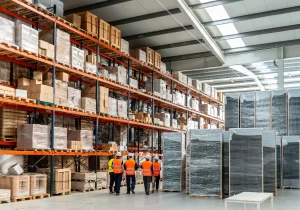
Warehouse automation strategies are placing greater emphasis on software, system integration and disciplined design as companies seek more reliable returns from capital investment. AI, orchestration platforms and digital twins are helping businesses improve performance while reducing the risk of costly implementation failures.
From Equipment Buying To End‑to‑end Orchestration
Warehouse investment decisions are becoming more structural than transactional. Instead of buying a single fleet of shuttles, shuttling systems, or autonomous mobile robots and hoping they integrate later, operations teams are seeking partners that can design and own the full solution lifecycle, from requirement definition through commissioning and support. Many organizations have leaner engineering benches than a decade ago, which puts more of the systems thinking burden on integrators and automation providers.
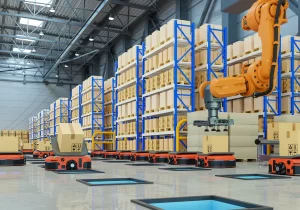
The technical center of gravity is shifting from hardware selection to orchestration. Most large facilities already run mixed environments with conveyors, shuttles, robotic picking, and manual zones sourced from multiple vendors. Without a unifying control layer, each subsystem behaves like an island, creating bottlenecks, idle time, and opaque capacity. This is why warehouse execution and orchestration platforms now sit at the core of new designs, coordinating work across people, robots, and legacy systems in real time.
Software has also become the primary lever for adaptability. Market data over the past two years shows demand volatility and product churn accelerating across sectors. Orchestration tools that can rebalance work by zone, change task priorities, and re-route orders based on carrier cut‑offs allow facilities to adjust without ripping and replacing equipment. This approach supports a more modular capital plan: core infrastructure lasts longer, while software absorbs more of the change.
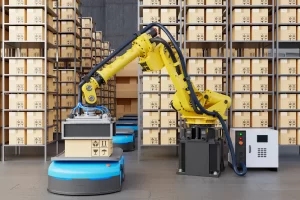
The industry is keeping humanoid robots at arm’s length for now. Analysts such as Gartner have pointed to the late 2020s as a realistic window for wider use of legged or anthropomorphic platforms in distribution centers. Current focus remains on proven technologies like goods‑to‑person shuttles, AMRs, and robotic arms tuned for high‑volume picking, while manual labor still handles irregular and unstable items such as soft bags, oversized components, and spherical products that defeat standard material handling flows.
AI Value, Digital Twins, and The Cost of Bad Design
Artificial intelligence now sits at the center of nearly every automation pitch, but adoption on the floor is uneven. Many teams still equate AI with generative tools, while established methods like computer vision and machine learning already run in areas such as predictive maintenance, path optimization, and anomaly detection. The emerging priority is to pinpoint where AI changes business outcomes: fewer exceptions, higher lines per hour, better dock utilization, or lower overtime, instead of generic ‘smart’ branding.
This demand for tangible benefit is reshaping software strategies. Recent industry reports highlight growing use of AI‑enabled labor planning, slotting, and work allocation, where models learn from order history and real‑time conditions to recommend task sequences. At the same time, governance has become essential. Teams are putting in place rules for how recommendations are surfaced, when human overrides apply, and how performance is audited, to keep algorithmic decisions aligned with safety, service, and cost targets.
The most expensive failures in warehouse automation have rarely stemmed from one malfunctioning machine. They usually trace back to flawed assumptions about volume mix, order profiles, and operating models. Several headline‑grabbing facilities in recent years closed or were downsized after demand shifted, labor costs changed, or promised throughput never materialized. Those outcomes have made pre‑investment validation a board‑level concern.
Digital twins and discrete‑event simulations are moving from experimentation tools to gating artifacts for capital approval. By modeling inbound variability, order cut‑off patterns, and peak scenarios, teams can pressure‑test layout, buffer sizing, and control logic before committing tens or hundreds of millions of dollars. Twins are also being linked to live data feeds so planners can run updated scenarios when promotions, network redesigns, or product portfolio changes hit, reducing the gap between design intent and reality.
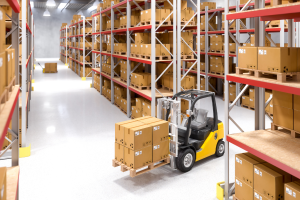
Yet even the best model cannot automate every task. Items that deform, roll, or lack consistent grasp points still defeat many robotic and conveyor solutions, keeping people in the loop for case building, exception handling, and quality checks. Industry data suggests human work will remain significant even in highly automated sites, which puts renewed emphasis on ergonomics, safety, and clear role design as automation density climbs.
Execution Capability Will Influence Automation Returns
As warehouse systems become more interconnected, long-term performance will depend on how effectively software, equipment and frontline teams operate together after deployment. Organizations that continuously measure throughput, system utilization and exception handling can refine automation over time, extending asset life while improving productivity without repeated rounds of capital investment.