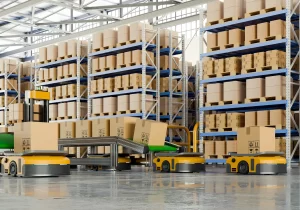
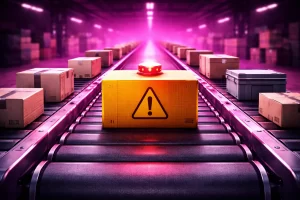
Picture a high-volume distribution center in the middle of peak season. Autonomous mobile robots move inventory across aisles while a vision-enabled robotic arm handles mixed-SKU depalletizing at the dock. A sensor flags an error. The arm stops. Within moments, upstream robots queue, downstream flow slows, and a human operator hesitates between resetting the system or escalating. In less than two minutes, the disruption ripples into the sorter. Throughput drops, not because of a technical failure, but because no one owns the decision logic for that moment.
This kind of scenario is becoming increasingly common as automation scales. The global warehouse automation market reached an estimated $33 billion in 2025 and is expected to approach $97 billion by 2035. At the same time, venture funding into physical AI surpassed $7.5 billion in 2024. The investment signals confidence in the technology. What remains underdeveloped is the leadership framework required to operate it.
Why Automation Breakdowns Start Outside the Technology
Most automation setbacks are not rooted in hardware limitations. They emerge from gaps in how systems are integrated and governed. A 2025 analysis from Logistics Viewpoints found that integration, not the underlying robotics, was the primary factor separating successful deployments from stalled ones. Many warehouse management systems were never designed to coordinate real-time orchestration across mixed fleets of robots and human workflows, leading to congestion, duplicated activity, and delayed responses to exceptions.
The financial exposure tied to these breakdowns is substantial. According to recent McKinsey research, supply chain disruptions can erode up to 45% of a company’s annual profits over a decade, with significant disruptions occurring roughly every 3.7 years. When the disruption originates internally, from poorly governed autonomous systems, the damage extends beyond cost. It undermines operational reliability and confidence in the system itself.
Recent joint analysis from the World Economic Forum and BCG reinforces this point. Their 2025 work on physical AI highlights that leading organizations are not simply layering automation onto existing processes. They are redesigning workflows end-to-end, aligning decision rights, data flows, and human roles with how autonomous systems actually behave in live operations.
From Process Manager to System Architect and Coach
Operating in this environment requires a shift in leadership posture. The role is no longer limited to managing throughput, labor, and schedules. It now includes designing how autonomy functions and ensuring people can intervene effectively when it does not.
As system architects, leaders define the boundaries of autonomy. They determine which workflows are fully automated, where human oversight is required, and how escalation paths are structured. When a robotic system fails, response protocols must trigger instantly, not after minutes of uncertainty. Ownership must also be explicit: every automated action requires a defined human accountable for its outcome. Equally important is telemetry, continuous monitoring that identifies performance drift before it escalates into disruption.
As coaches, leaders build the human capabilities that sustain these systems. Autonomous operations depend on people who can interpret system behavior, resolve exceptions, and refine workflows over time. This includes standardized response procedures, safety practices in shared environments, and structured feedback loops that improve system performance continuously.
Neither role stands alone. Even well-designed systems fail when teams lack the skills to manage exceptions. Conversely, highly capable teams struggle within poorly structured systems. The advantage lies in combining both disciplines, designing robust systems while developing the workforce to operate them.
This shift also changes how performance is measured. Traditional metrics such as units per hour remain relevant, but they no longer capture the full picture. The focus is moving toward exception economics: how often systems escalate, how quickly issues are resolved, and what each disruption costs in terms of throughput, quality, and safety.
Two metrics illustrate this shift clearly. Time-to-recover measures how quickly operations return to normal after an exception. A facility that resolves disruptions in under a minute operates fundamentally differently from one that takes over ten minutes, even if both report similar output at shift end. Time-to-proficiency tracks how quickly employees become effective in hybrid roles that combine operational expertise with system awareness. As automation expands, this becomes a direct indicator of how well organizations are aligning workforce development with technology adoption.
Alongside these metrics, workforce models are evolving. The distinction between operations and technology roles is blurring. New positions, such as robot coordinators, automation technicians, and real-time exception managers, are emerging across the industry. These roles are grounded in operational execution but require fluency in how autonomous systems function, fail, and adapt.
Where Autonomy Actually Breaks or Holds
In practice, the most resilient automated operations are not those with the highest uptime, but those that have already mapped how failure unfolds in real time. Industry implementations show that organizations running structured “failure drills” for robotics, similar to safety simulations, tend to reduce recovery times materially because decision ownership is pre-assigned before disruption occurs. That discipline reframes autonomy from a productivity tool into an operational system that must be stress-tested continuously. Over time, the gap will not emerge in how systems perform under ideal conditions, but in how quickly organizations normalize performance when those conditions inevitably break.