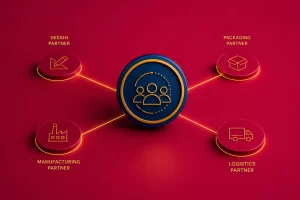
Jabil is expanding AI infrastructure capacity across multiple continents while keeping capital intensity unusually low. The strategy relies on disciplined capacity planning, higher-value manufacturing capabilities, and long-term component allocation agreements that allow the company to scale revenue, margins, and cash flow without a corresponding surge in fixed assets.
In Brief
- Capacity is expanding about 10% through a distributed network while capex stays at roughly 1.5–2% of revenue.
- AI-driven growth is routed through higher-value capabilities and services that lift margins above 6% as utilization improves.
- Procurement shifts from transactional buying to strategic allocation agreements, reshaping how component risk is managed upstream.
The Operating Shift: Scaling AI Capacity Without Heavy Assets
As AI infrastructure spending accelerates, many manufacturers face a familiar challenge. Demand for servers, networking equipment, power systems, cooling technologies, and data center hardware is rising rapidly, but building enough capacity to support that demand can strain balance sheets and pressure returns.
Jabil is pursuing a different path. The company expects fiscal 2026 revenue of approximately $35 billion, with AI-related revenue projected to reach $13.6 billion, up from $9 billion a year earlier. Yet capital expenditures remain anchored at roughly 1.5% to 2% of revenue, while adjusted free cash flow is expected to exceed $1.4 billion. For supply chain leaders, the significance is not simply the pace of AI growth. It is the operating model behind that growth. Jabil is demonstrating how a global manufacturing network can absorb substantial capacity expansion without abandoning capital discipline.
Scaling Capacity Through Network Design
The foundation of the model is a staged approach to capacity expansion. Rather than building large facilities ahead of demand, Jabil is adding capacity in phases across North Carolina, Memphis, Mexico, India, and Croatia. New sites and expansions are being tied directly to committed customer programs and visible demand ramps.
The North Carolina facility provides a useful example. Focused on AI and data center infrastructure, the site is expected to reach full ramp around January 2027. Management has outlined a progression from roughly $1 billion in annual revenue during its first year to $3 billion by year three.
Other facilities are following similar trajectories. Several locations are expected to enter meaningful production during early 2027, creating a staggered network expansion rather than a single large-scale buildout. The approach reduces execution risk while allowing utilization to rise quickly once programs move into production.
This model requires tight coordination across planning, operations, and customer teams. Capacity decisions are tied to specific programs rather than broad market forecasts. New facilities must reach productivity targets rapidly because the economics depend on high utilization rather than excess capacity. The result is a supply chain designed around demand visibility rather than speculative expansion.
AI Growth Depends on Higher-Value Manufacturing
Capacity alone does not explain the economics. Jabil’s margin expansion is being driven by a deliberate shift toward higher-value products and services inside the AI infrastructure ecosystem. The Intelligent Infrastructure segment, which includes much of the company’s AI-related activity, delivered operating margins of approximately 6.1% in the latest quarter, up 80 basis points year over year. Management believes enterprise operating margins above 6% are sustainable as AI programs continue to scale.
The improvement comes from product mix. Rather than focusing solely on servers and standard hardware assembly, Jabil is expanding into power systems, liquid cooling technologies, silicon photonics, networking equipment, transformers, switchgear, and modular power distribution solutions. These categories typically require deeper engineering expertise and carry stronger margins than traditional electronics manufacturing. The acquisition of Hanley strengthens that position by adding modular power infrastructure capabilities and recurring service revenue tied to data center operations.
For supply chain organizations, this reflects a broader trend across industrial networks. Margin expansion increasingly comes from technical capabilities, integration expertise, and lifecycle support rather than volume alone. Jabil’s facilities are being configured around these higher-value product families, allowing engineering talent, manufacturing resources, and operational infrastructure to support multiple programs from shared locations. That concentration improves asset utilization while increasing revenue generated per square foot of capacity.
Procurement Moves Upstream
Perhaps the most significant operational shift is occurring within procurement. AI infrastructure growth depends heavily on constrained components, including high-bandwidth memory, advanced printed circuit boards, and specialized semiconductor-related technologies. Traditional purchasing models centered on price negotiations are becoming less effective when supply availability is the primary constraint.
Jabil’s sourcing strategy is adapting accordingly. Supplier relationships are increasingly structured around allocation agreements, long-term commitments, and shared visibility into future demand. Access to critical components has become as important as unit cost. This changes the role of procurement.
Instead of reacting to immediate requirements, sourcing teams must manage multi-quarter demand signals, secure allocation commitments, and integrate supplier capacity planning directly into manufacturing forecasts. Customer contracts now influence sourcing decisions more directly. Large hyperscale AI customers often possess significant purchasing leverage, creating opportunities for coordinated allocation strategies across the supply chain. The result is a procurement model that resembles strategic capacity management rather than transactional buying. For many supply chain organizations, this may become a defining characteristic of AI-era sourcing.
Managing Growth Through Working Capital Discipline
Rapid expansion inevitably places pressure on inventory and working capital. Jabil’s inventory metrics reflect that reality. Inventory days reached 84 days during the latest quarter, above the company’s normal target range. Management attributes the increase largely to timing differences associated with AI infrastructure shipments and facility ramps. Importantly, the elevated inventory is tied to specific customer programs and scheduled deployments rather than speculative stock accumulation.
Approximately $200 million of finished goods inventory is expected to convert into shipments during the following quarter, while additional demand from AI rack deployments should further normalize inventory levels. This distinction matters. The company appears willing to temporarily absorb higher working capital requirements when inventory is directly linked to confirmed demand. The objective remains rapid conversion back into cash once deployment schedules are executed. Maintaining that discipline becomes increasingly important as multiple facilities move through ramp phases simultaneously.
The Constraint Is Coordination, Not Capital
The most interesting aspect of Jabil’s strategy is what it suggests about the next phase of AI infrastructure growth. The primary limitation is no longer access to capital. Jabil has demonstrated the ability to support billions of dollars in AI-related growth while maintaining relatively modest capital expenditures. The larger challenge lies in coordinating customers, suppliers, facilities, logistics, and component availability across a rapidly expanding global network.
Multiple sites are entering production simultaneously. Critical components remain constrained. Demand from hyperscale customers continues to accelerate. Under those conditions, success depends less on spending more money and more on orchestrating capacity, inventory, procurement, and customer commitments with precision. That operating discipline increasingly separates high-performing supply chains from those struggling to keep pace with AI infrastructure demand.
The Next Test of the Asset-Light Model
Jabil’s AI strategy reflects a broader evolution in manufacturing and supply chain design. Rather than building large asset bases to capture growth, the company is using network flexibility, specialized capabilities, and disciplined procurement governance to expand capacity while preserving cash generation and margin performance. The model has already produced strong results. AI revenue is growing rapidly, margins are improving, and free cash flow remains robust despite significant network expansion.
The next phase will test whether those economics can hold as additional facilities come online and component constraints persist. If they do, Jabil may provide one of the clearest examples of how manufacturers can participate in the AI infrastructure boom without sacrificing the capital discipline that investors increasingly expect.