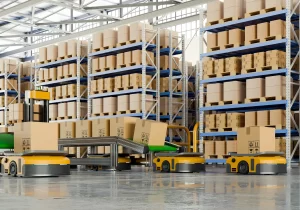
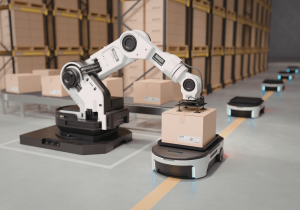
Warehouse operators are deploying larger robotic fleets, but productivity gains increasingly depend on how effectively those machines work alongside people. New INFORMS research suggests that real-time coordination between workers and robots can deliver greater performance improvements than simply adding more automation.
From Single Bots To Coordinated Fleets
Warehouse automation once centered on deploying individual robots to replace specific manual tasks. New findings from INFORMS point to higher performance when robots and people share work dynamically and adjust continuously to live conditions. Study co-author Arash Azadeh of Rutgers University describes the strongest results coming from teams that can reassign work on the fly instead of locking tasks in at the start of a shift.
The research tested how different task allocation rules affect throughput and stability on the floor. Operations ran more smoothly when robots coordinated their moves collectively and responded together to congestion, priority changes, and delays. That pattern mirrors swarm behavior in nature, where large groups adapt through local decisions rather than a single controller dictating each move.
This approach aligns with a broader investment cycle already underway. Gartner expects half of new warehouses in developed markets built by 2030 to be designed as ‘robot-centric’ facilities, and forecasts that by 2028 about 80% of warehouses and distribution centers will use some form of automation equipment. As fleets scale, the cost of poor coordination becomes more visible in bottlenecks, idle time, and unstable labor plans.
The shift also reinforces a core lesson from modern warehouse intelligence work: robots only deliver their full value when they sit on top of accurate data, robust layout models, and real-time orchestration. Reference designs now favor virtual twin mapping that captures aisle rules, no-turn zones, equipment limits, and safety constraints so that algorithmic decisions reflect the true facility, not an abstract grid.
Human-Robot Orchestration as a System Design Problem
Despite rising levels of automation, most warehouses still depend heavily on people for exception handling, maintenance, complex picking, and judgment calls under pressure. The INFORMS research frames collaboration as a system design challenge rather than a staffing debate. Operations performed better when human work and robot work were treated as a single shared pool, with software continuously optimizing who should do what.
In practice, that means moving from static work waves to live assignment. Mature systems already use digital twins, smart batching, and dynamic routing to cut travel and improve labor utilization by 5% to nearly 30%. When robotic fleets plug into the same orchestration layer, the engine can consider robot positions, charge levels, human availability, congestion patterns, and order deadlines at the exact moment a new task is created.
This model lines up with how intelligent systems are evolving more generally. Recent warehouse deployments show that intelligence starts with clean data and constrained algorithms, not with unconstrained autonomy. Agentic or generative AI tools only work reliably when they operate inside clear safety rules, performance guardrails, and override paths, especially during seasonal peaks when errors carry the highest cost.
Azadeh notes that effective collaboration emerges when systems can ‘flex, respond and self-organize in real time.’ That principle applies whether the decision engine is a rules-based optimizer, a swarm coordination algorithm, or a more advanced AI layer. The anchor remains the same: clearly defined boundaries for space, safety, and service, with continuous feedback from floor conditions.
Coordination Is Emerging as The Real Constraint
Robotic hardware continues to improve, but many warehouses are discovering that equipment alone does not determine performance. As fleets grow larger and workflows become more interconnected, the ability to coordinate tasks, manage congestion and balance work between people and machines is becoming increasingly important. Facilities with similar automation investments can achieve very different outcomes depending on how effectively they orchestrate activity across the operation.