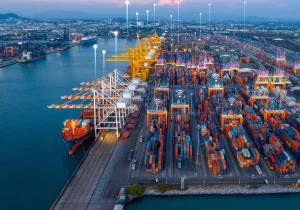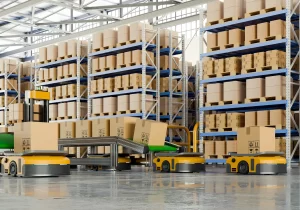
Warehousing has never lacked innovation. From RF scanning to voice picking and early goods-to-person automation, each wave improved visibility or efficiency in a specific slice of operations. Yet most of these systems shared a blind spot: they executed instructions without truly understanding the physical environment they operated in. That limitation is now being addressed as physical AI and 3D vision reshape how warehouses perceive space, make decisions, and coordinate work.
At its core, physical AI combines machine vision, depth perception, and autonomous planning. Together, they allow robots and systems not just to follow predefined paths, but to interpret three-dimensional environments, reason about what is happening, and act accordingly. The shift is already reflected in market momentum. Recent analysis places the global warehouse automation market at roughly $33 billion in 2025, with forecasts approaching $97 billion by 2035. In parallel, research published in 2025 estimates the AI-in-warehousing segment at around $10–11 billion in 2024, with projections reaching $40–60 billion by the early 2030s as vision systems and AI-driven robotics become embedded across facilities.
Operational results from live deployments highlight why. Documented case studies show AI-enabled AMRs and vision-guided systems delivering throughput gains of 25% to 40%, cutting labor and inventory costs by 15% to 30%, and pushing picking accuracy well beyond 99.5% in high-volume environments. These gains stem less from raw automation and more from systems that can interpret context and adapt when conditions change.
From Obstacle Detection to Spatial Intelligence
Most warehouse automation still treats perception as a yes-or-no problem: is an obstacle present or not? Depth cameras and vision AI move perception into a richer domain. By combining standard imaging with depth data and techniques such as visual SLAM, robots build a continuous 3D understanding of aisles, racks, pallets, equipment, and people, each with distance, shape, and motion.
Processing this information at the edge, often directly on the camera, is critical. Real-time depth map generation reduces latency and enables safe operation in shared human–robot environments. It also allows robots to distinguish between permanent structures, such as racks or walls, and temporary conditions, like a pallet left in an aisle or a lift truck crossing a lane.
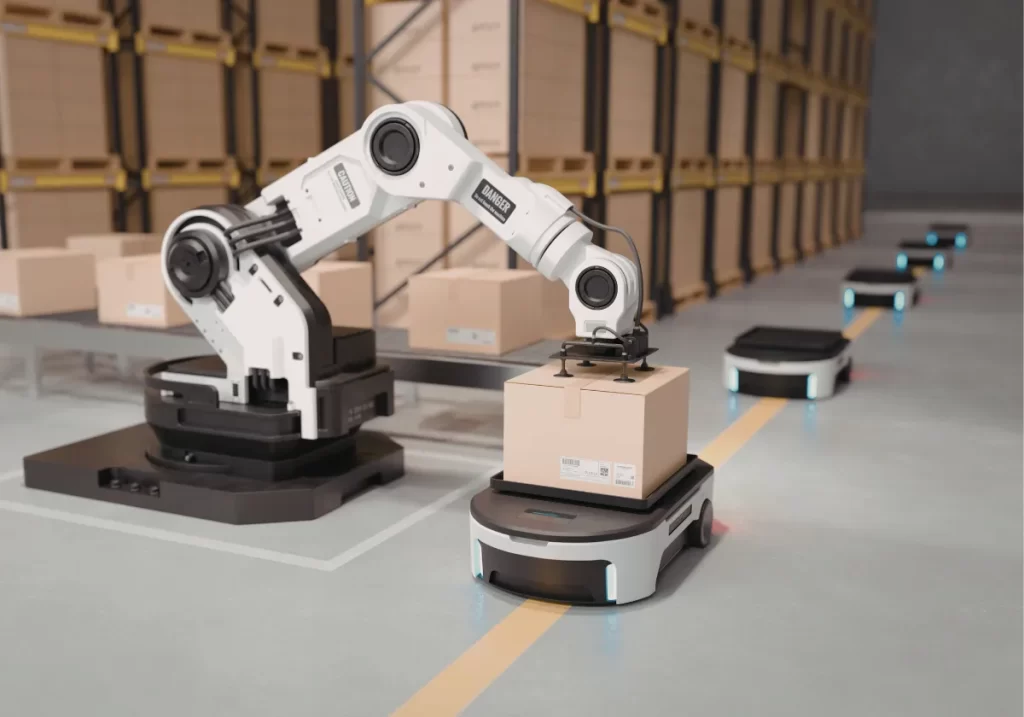
This spatial intelligence changes behavior. Mobile robots can reroute around congestion instead of stopping. Robotic arms equipped with vision and depth sensing can adjust grip points dynamically, identify box faces on skewed pallets, and depalletize mixed SKUs without brittle staging requirements. The result is automation that is more tolerant of real-world variability.
At a system level, distributed vision creates living digital twins. Fixed edge devices mounted overhead, paired with 3D depth cameras and on-device AI, continuously model the facility as it exists now, not as it was designed months earlier. These live models support flow optimization, safety monitoring, and shared situational awareness for both people and machines. Rather than redesigning buildings around robots, robots are increasingly adapting to existing buildings.
Physical AI Shifts Automation From Tasks to Missions
If vision provides perception, physical AI provides intent. Traditional automation relies on narrowly defined tasks: move from point A to point B, pick an item from a known location, deliver a tote to a fixed station. Physical AI raises the abstraction level.
Instead of scripts, systems are given missions: clear inbound doors, replenish a zone ahead of a shipping wave, or keep outbound staging within capacity limits. Robots then decompose those missions into tasks, plan routes based on current congestion and priorities, and re-plan when conditions change, whether a door closes, a rush order arrives, or an aisle becomes blocked.
This approach is already visible in new automation projects that use AI for dynamic task allocation, traffic management, and exception handling. Rather than halting when reality diverges from the plan, these systems adjust continuously, much like an experienced supervisor managing a busy shift, but at machine speed and across an entire fleet. None of this works without reliable 3D perception; robots cannot reason about door heights, trailer positions, or nearby workers without trustworthy depth data.
Vision-Quality as an Operational Asset
A growing body of field data shows that the effectiveness of physical AI is increasingly governed by the quality of the visual information feeding it. Facilities adopting depth-rich perception are finding that lighting stability, camera placement, reflective surfaces, and material handling practices directly influence how reliably autonomous systems interpret their environment. This introduces a new operational lever: investing in visual conditions with the same rigor once applied to racking standards or conveyor design. As more robots rely on scene understanding rather than fixed paths, the warehouse’s “visual infrastructure” becomes a determinant of throughput and safety. Forward-looking operators are beginning to recognize this, not as an IT concern, but as a core component of network reliability that will shape how future sites are built and retrofitted.