Warehouse productivity increasingly depends on how safely forklifts, pedestrians and equipment can share the same space. As facilities handle higher volumes with denser layouts and longer operating hours, companies are investing in visibility technologies including warning lights and onboard cameras to reduce disruptions, improve traffic flow and support consistent throughput.
Visibility as a Throughput Constraint
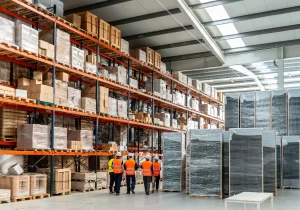
Modern storage and fulfillment sites run at a different tempo than they did even five years ago. Taller racking, denser slotting, and extended operating hours have raised the number of forklift and pedestrian interactions on every shift. In that environment, limited sight lines at intersections, dock doors, and transfer zones become a direct cap on how much volume a building can handle.
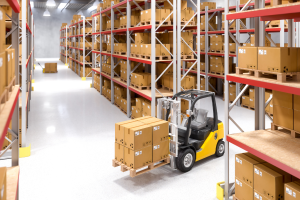
The response is a new layer of visibility infrastructure built around forklifts and their immediate operating envelope. Blue spot lights throw a moving signal on the floor in front of an oncoming truck so anyone stepping out of a side aisle can react before the vehicle appears. Red zone lights project a clear perimeter along the sides and rear of the machine, giving nearby workers a visual boundary they can read instantly without looking up from their task.
Safety cameras on masts, overhead guards, or rear frames give operators a live view into blind areas, into trailers, around rack ends, or behind stacked loads that block the mirror. When integrated with in-cab displays, these feeds shorten the time operators spend inching through tight maneuvers and reduce their dependence on hand signals in noisy bays. Industry reports indicate that facilities combining cameras with marked exclusion zones see fewer near misses and more consistent travel speeds in constrained areas.
As e-commerce and retail networks push for shorter order cut-off times, these micro-gains matter. If operators must creep through every cross-aisle or stop completely at each blind junction, cycle times lengthen and staging lanes back up. When pedestrians can anticipate forklift paths through light projections and operators can see around obstructions, the building can sustain a higher, more stable pace without relying solely on aggressive training or procedural discipline.
Safety Infrastructure as an Operational Design Choice
The discussion around this equipment has moved beyond catalog shopping for add-ons. Operations teams are mapping light patterns, camera positions, and alert intensities to the specific geometry and traffic patterns of their buildings. The question is less about whether to fit a warning light and more about how to tune the combination of tools for different zones such as docks, bulk storage, pick modules, and yards.
That tuning requires good data. Facilities with digital incident logs and telemetry from forklift fleets can pinpoint where impact alarms spike, where near misses cluster, and where operators habitually slow down. Those hot spots become candidates for targeted visibility interventions, red zones at tight rack ends, blue beams at high-crosswalk intersections, or cameras aimed at dock approaches used heavily at night.
Recent trade data shows that warehouse insurance and workers’ compensation costs rise sharply with even modest increases in incident rates. That reality links visibility investments directly to total landed cost, not just safety metrics. A lift truck fitted with clear perimeter lighting and cameras may carry a higher upfront price, but it can reduce downtime, avoid damage to racks and doors, and maintain higher utilization of dock positions and loading slots.
There is also a workforce dimension. In a tight labor market, facilities that pair automation and density with obvious, predictable safety cues tend to find it easier to retain experienced operators and recruit new ones. Clear visual boundaries lower cognitive load for both drivers and pedestrians, which reduces fatigue on long shifts and helps new staff acclimate faster to complex layouts.
Warehouse Design Is Increasingly Shaped by Human-Machine Interaction
As warehouses become denser and more automated, visibility systems are being incorporated into facility design alongside racking layouts, traffic flows, and material handling equipment. Cameras, projected warning zones, pedestrian alerts, and fleet telemetry work together to create a consistent visual environment that supports both people and machines. That integrated approach also provides a growing stream of location and movement data, allowing facilities to refine traffic patterns, identify recurring congestion points, and adjust layouts based on how work is actually performed rather than how it was originally planned.