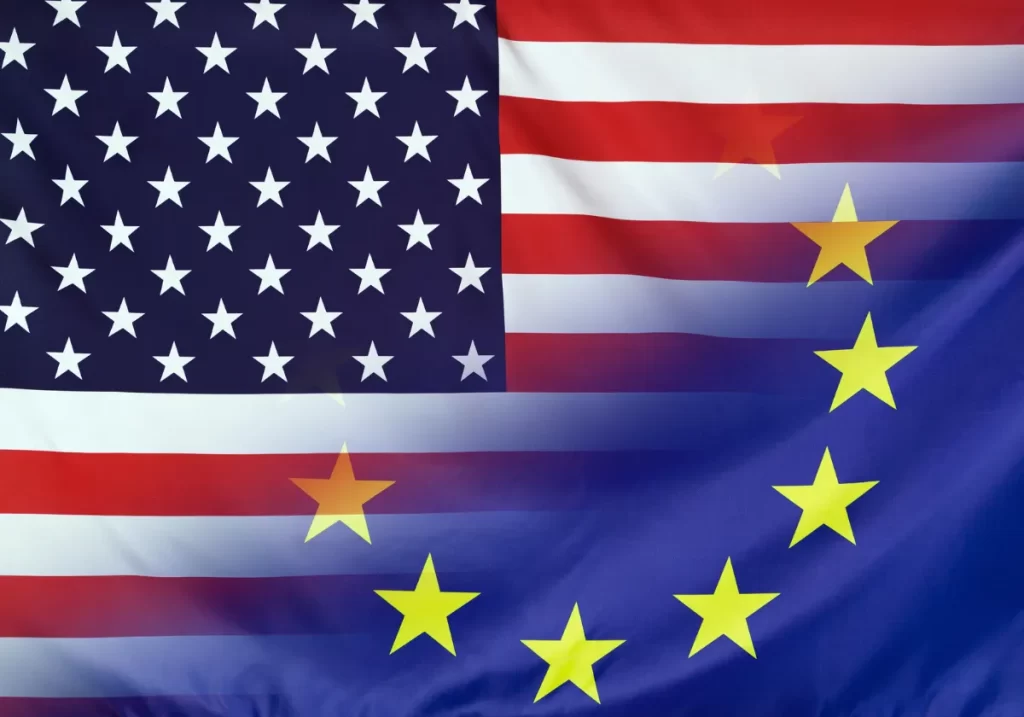
The European Union has paused its trade framework with the United States after Washington moved to reassert tariff authority in the wake of a Supreme Court ruling. The decision signals a new period of uncertainty for companies that depend on stable transatlantic flows, particularly as recent global trade analysis shows rising sensitivity to sudden tariff changes.
Legal Uncertainty Forces Brussels to Hit Pause
The European Union has suspended progress on its framework trade agreement with the United States while it evaluates the implications of a Supreme Court ruling that struck down many tariffs enacted by President Donald Trump. Hours after the ruling removed his ability to rely on the International Emergency Economic Powers Act, Trump issued an executive order setting a 10% global tariff and later announced plans to increase it to 15%. As of Monday morning, no formal documentation confirming that raise had been released.
Brussels responded by saying it needs “full clarity” on Washington’s intentions before advancing the agreement. In a statement over the weekend, the European Commission said the emerging policy environment does not align with the commitment to “fair, balanced, and mutually beneficial” trade laid out in the EU-U.S. Joint Statement of August 2025. That assessment prompted European Parliament officials to suspend a vote planned for Tuesday on legislation tied to the pact, according to Bernd Lange, chair of the Parliament’s International Trade Committee.
Despite the legal turbulence, the Commission said it still expects the United States to uphold the terms of the framework deal. It reiterated that the U.S. should not exceed the deal’s 15% cap on tariff increases applied to EU goods, a ceiling that also governs sectors already targeted under Section 232 measures such as autos and lumber, along with potential levies on categories including pharmaceuticals.
U.S. Tariff Mechanics Add to the Complexity
Trump’s proposed 15% global tariff matches the statutory maximum allowed under Section 122 of the Trade Act of 1974, the authority he is now using to impose the duty. What remains unresolved is whether the new tariff would layer on top of the rates set through recent U.S. framework agreements. Many of those deals were designed to offset earlier IEEPA-based tariffs, now invalidated by the Court, leaving policymakers on both sides of the Atlantic uncertain about how prior commitments interact with the new approach.
The Commission noted it has been in ongoing contact with U.S. officials and intends to keep pushing toward tariff reductions consistent with the joint agreement. It emphasized the importance of a stable transatlantic environment at a time when tariff volatility has become a growing operational concern. According to recent trade reports, both the World Trade Organization and the World Economic Forum have highlighted how abrupt shifts in tariff policy are reshaping sourcing decisions, compliance demands, and risk modeling across global supply chains.
This month’s pause marks the second interruption to the EU-U.S. framework in recent weeks. The bloc froze progress in January after Trump threatened tariffs on eight European countries for opposing his bid to annex Greenland. Those threats were later rescinded, allowing negotiations to resume, until last week’s ruling once again clouded the outlook.
What the Pause Means for Cross-Border Planning
The latest delay signals how fast the architecture of transatlantic trade can shift when legal authority and political strategy collide. While attention has centered on tariff ceilings, the more consequential question may be how companies recalibrate contract terms, shipment timing, and inventory positioning in an environment where tariff regimes can change within days. Recent data shows that global manufacturers are increasingly spreading production across multiple jurisdictions not only to hedge geopolitical risk but also to buffer against abrupt legal reversals. That trend suggests the EU-U.S. standoff will be read as another reminder that predictability, not just tariff levels, has become one of the most valuable assets in international trade.