Third-party logistics providers are taking on a larger role in supply chain planning as companies redesign networks around resilience, faster fulfilment and stronger cash performance. Research from Fidelity Fulfilment shows that changing manufacturing footprints, distributed inventory and targeted technology investments are reshaping what customers expect from their logistics partners.
3PLs Move Upstream In Network and Capital Decisions
Years of disruption have ended the era of stable, efficiency-first networks that left logistics partners working at the edge of decisions already made. Research from Fidelity Fulfilment indicates that 87% of e-commerce businesses expect to change their primary manufacturing location within three years, which signals a redesign of where and how supply sits in relation to demand. Those shifts alter freight lanes, inventory buffers, regional lead times, and the risk profile of entire categories.
Logistics providers are now being drawn into that redesign. Location moves, supplier diversification, and nearshoring do not function as standalone strategies; they succeed only when inbound flows, storage models, and last-mile capacity are re-planned in tandem. As a result, 3PLs are increasingly part of early conversations on plant placement, entry into new markets, and the structure of multi-node networks.
Cost pressure is accelerating this shift. In a market where warehousing and transport costs continue to rise, customers need networks that protect cash as well as service. Reference operators highlight bonded warehousing as a basic expectation rather than a niche service, when imported goods sit in storage for months, deferring duty and tax until dispatch can materially improve working capital. That turns facility selection into a balance sheet decision, not just a location choice.
At the same time, contract horizons are shortening. Many customers now favor two- to three-year agreements, making it harder for logistics providers to justify heavy, long-payback investments in fixed automation or speculative capacity. The response emerging from leading operators is modularity, smaller, targeted enhancements that upgrade performance without locking either side into inflexible asset bets.
Distributed fulfilment is the clearest expression of this new logic. Fidelity Fulfilment data shows that 86% of e-commerce businesses are likely to add fulfilment centers within three years, pulling inventory closer to end customers. That reduces single-node exposure, cuts lead times, and supports differentiated service promises, but it also complicates inventory planning, slotting, and transport orchestration. Operating that complexity at an acceptable cost has become a defining test for 3PL capability.
Technology Becomes a Selective, Insight-Led Differentiator
Network redesign has raised the bar for digital infrastructure. In Fidelity Fulfilment research, 99% of e-commerce businesses view fulfilment technology as central to resilience, which reflects a broader shift across the sector. Distributed footprints and shorter contracts leave little room for manual, batch-style control; operators need live data on stock, capacity, and flows to keep multi-node models economically viable.
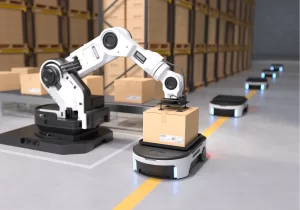
The lesson from current adopters is that technology now earns its keep by removing friction from specific processes rather than serving as a generic modernization badge. One operator describes automation decisions in blunt terms, not automation for its own sake, but targeted tools that solve a defined operational problem at the right unit cost. That philosophy shows up in the deployment of inventory-scanning robots to handle repetitive stock counts across large facilities. In a site with tens of thousands of rack locations and millions of annual order movements, the ability to complete weekly counts at low marginal labor cost can be ‘absolutely invaluable.
Digital twinning sits behind many of these deployments. Robotic scans feed a live representation of the warehouse that flags discrepancies, highlights congestion, and pinpoints storage issues. Teams can see exactly where an error originated and correct it before it cascades into missed picks or service failures. That supports the broader shift noted in Fidelity Fulfilment research, technology is no longer judged only on throughput; it is valued for how it enables faster, better decisions under volatile conditions.
Industry reports echo this trend across transport and inventory management. Real-time visibility platforms, API-connected carrier networks, and predictive analytics for demand and supplier performance are becoming table stakes rather than differentiators. Yet the reference stories underline a practical constraint, customers remain cautious about long-term commitments, so 3PLs are favoring lower entry-point technologies such as RFID, modular robotics, and software layers that can be deployed incrementally.
Sustainability is threading through these choices rather than sitting in a separate workstream. Fidelity Fulfilment research shows that 89% of e-commerce businesses report positive impact from sustainability initiatives, with even higher figures in the UK and EU. For logistics operations, that often means redesigned routes, packaging optimization, and more energy-efficient warehouse processes. When those actions also reduce handling, mileage, or rework, they reinforce the commercial case rather than compete with it.
Network Flexibility Influences Long-Term Value
As manufacturing locations, customer demand and trade patterns continue to evolve, logistics networks will require greater flexibility than traditional hub-and-spoke models were designed to provide. Modular warehouse capabilities, scalable technology and adaptable contract structures give companies more options to adjust inventory positioning and fulfilment capacity without repeated network redesigns. Those characteristics are becoming increasingly relevant as supply chain investments are expected to support both day-to-day execution and long-term growth.