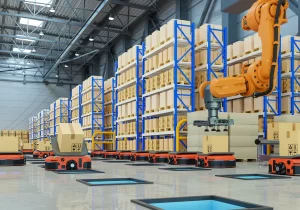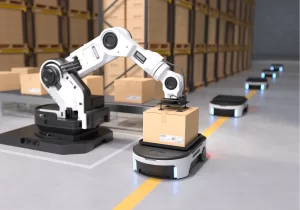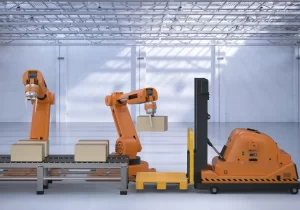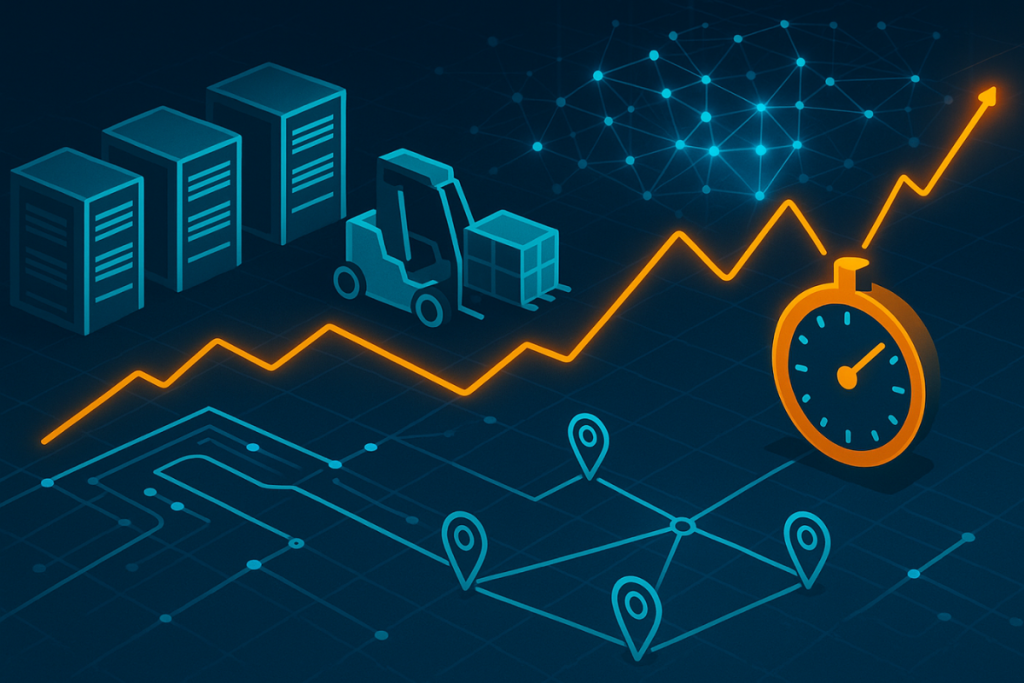
Warehouse congestion has traditionally been diagnosed after productivity drops, when pick paths clog, dock queues build, or AMRs idle waiting for charge cycles to turn. But as fulfillment networks densify and SKU proliferation accelerates, reactive problem-solving is no longer enough. Operators are now turning to item-level topology forecasting, a method that predicts congestion before it forms by analyzing SKU velocity patterns, AMR battery cycles, dock composition, and pick-path saturation.
Instead of planning space and labor around broad throughput forecasts, facilities are beginning to model how specific SKU clusters move through the building and where friction will emerge hours, or even days, ahead.
From Throughput Monitoring to Topology Simulation
Legacy performance tools watch for lagging KPIs: longer pick cycles, traffic jams in narrow aisles, or inbound stalls at the dock. By the time metrics deteriorate, peak windows are already compromised.
Item-level topology forecasting flips the sequence. AI engines analyze SKU velocity tiers, demand seasonality, and order mix alongside AMR battery discharge curves, charger availability, and historical congestion patterns. The system then simulates flow ahead of live operations, highlighting:
The goal isn’t simply to identify pressure-points, it’s to orchestrate inventory, bots, labor, and docks before a slowdown begins.
A New Forecasting Stack on the DC Floor
Leading deployments are assembling a new forecasting layer inside the warehouse tech stack:
1. SKU Velocity Graphs: Facilities are moving beyond ABC slotting and static velocity tiers. SKU velocity graphs continuously model demand acceleration, seasonal patterns, and cross-SKU co-movement to identify clusters that will stress adjacent zones when volume spikes. These graphs track not only fast-movers, but “flash-turn” SKUs that rapidly shift tiers during promotions or channel swings. Operators then simulate the spatial impact, where SKU groups will over-concentrate pick density, overwhelm put-walls, or strain tote lanes, and pre-position labor, totes, and buffer space before the surge.
2. Battery-Cycle Load Models: Instead of monitoring AMR battery levels reactively, load models forecast charge-cycle convergence across the fleet, factoring in route length, lift frequency, acceleration patterns, and historical discharge curves. This enables facilities to sequence missions so robots don’t cluster at chargers simultaneously or fall below usable charge bands during peak windows. Models also identify the right cadence for hot-swap batteries versus trickle charging, ensuring power availability aligns with wave launches and high-utilization shifts.
3. Pick-Path Heatmaps: Pick-path heatmaps merge real-time order mix signals with slotting configurations and known travel bottlenecks to predict congestion down to aisle and segment level. Rather than waiting for scanners or WES data to flag slowdowns, the system forecasts where pick density will spike, where cross-traffic will intensify near packout or replenishment zones, and which aisles will hit dwell-time thresholds. Facilities can then adjust slotting, rebalance waves, or temporarily designate one-way traffic flows to avoid choke points before they form.
4. Dock Mix Algorithms: Dock bottlenecks rarely stem from volume alone, they arise from variability. Algorithms forecast staging density and flow based on trailer mix (TL, LTL, parcel), pallet weights and heights, unload profiles, and material-handling cadence. They also evaluate how mixed freight will interact with labor availability, yard timing, and door assignments. The output is proactive sequencing: shifting doors, pre-allocating buffer space, and staging pallets in optimized patterns so inbound and outbound windows stay balanced even during capacity spikes.
5. Dynamic Task Shaping: Instead of static task dispatch, dynamic task shaping anticipates where workload imbalances and robot clustering will arise and adjusts assignment logic before load hits the floor. The engine reroutes bots to alternate charging or pick paths, rotates SKU locations temporarily to flatten demand density, and reshapes human pick routes to minimize cross-flow. During peak bursts, it can split tasks across zones, re-sequence replenishment, or pre-stage totes to absorb demand without saturation, turning orchestration into a predictive discipline rather than a reactive scramble.
This allows supervisors to pre-empt congestion by redistributing inventory positions, sequencing waves differently, or staging battery swaps ahead of charge peaks.
Capacity Stability Emerges as a Planning Variable
As facility density increases and automation fleets multiply, congestion risk becomes a measurable input to capital and labor planning rather than an operational byproduct. The next wave of deployments will likely treat flow stability the way large transportation networks treat dwell time: quantified, forecasted, and reviewed alongside throughput and service targets. That shift points to a practical reframing, congestion management moves from episodic troubleshooting to an ongoing planning variable that shapes slotting decisions, shift design, and automation scaling models.