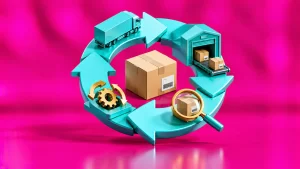
Logistics networks have always accepted downtime as a cost of doing business, lane resets, carrier swaps, WMS maintenance windows, fulfillment halts to rebalance labor or inventory. But with automation and real-time orchestration accelerating, downtime is becoming a competitive liability. A new operational model is emerging: zero-downtime logistics networks designed to rotate facilities, carriers, and digital nodes the way cloud platforms self-heal servers. The goal is simple, no single point in the network should ever require a pause.
Rather than rebuilding networks around static utilization and scheduled resets, operators are engineering flows that continuously reassign capacity, talent, and automation around stress points in real time. The mindset shift mirrors hyperscale tech: resilience through live substitution, not shutdown.
From Scheduled Stoppages to Self-Healing Motion
Traditional logistics assumes friction points: a carrier backlog, a conveyor outage, a sortation lane down for inspection. These events trigger cut-offs, buffers, and manual overrides. But automation and predictive intelligence now make pre-emptive continuity possible.
Zero-downtime logistics uses live telemetry, from AMRs, dock activity, yard queues, congestion maps, and carrier ETAs, to detect emerging bottlenecks and rotate assets before service breaks. Key enablers include:
Designing the Self-Healing Logistics Stack
Organizations moving toward zero-downtime operations are building new orchestration layers:
1. Real-Time Resilience Engine
A real-time resilience engine constantly evaluates network health, scanning for sub-second deviations across flow, labor, and automation signals, not just catastrophic failure events. It ingests:
Instead of responding to outages, the engine anticipates performance decay and pre-triggers corrective motion: re-sequencing waves, rebalancing load across sortation lines, and shifting parcel volume between parcel partners seconds before degradation becomes visible to humans on the floor. This is not system monitoring. It’s operational telemetry shaping decisions in flight.
2. Failover Routing Rules
Zero-downtime networks encode failover logic directly into orchestration layers, the logistics equivalent of BGP routing in internet infrastructure.
Critically, these rules are not static SOPs. They are continuously trained and updated based on live network behavior, peak learnings, inbound mix, labor availability, weather feeds, and geopolitical signals.
3. Modular Facility Zones
Physical environments must evolve to support digital continuity.
Facilities behave like distributed compute grids: self-contained modules with hot-swap capability that keep throughput intact regardless of where stress occurs.
4. Edge Compute for Local Continuity
Cloud latency is not theoretical in logistics, a 150-millisecond lag during peak routing can cascade into multi-minute throughput losses. Leading operators are pushing orchestration closer to the floor.
The result: facility performance that behaves like high-availability financial trading systems, local autonomy for speed, global visibility for optimization.
5. Continuous Quality Checks
Zero-downtime networks cannot wait for exception fires. Health assurance becomes continual.
Instead of quarterly testing and maintenance windows, reliability becomes a rolling process that detects weaknesses before they metastasize. Quality assurance shifts from periodic inspection to continuous observation and correction, the same evolution that made hyperscale cloud platforms near-perfectly reliable.
Flow Becomes a Governance Standard
As uptime becomes measurable in the same language as fill rate and OTIF, logistics firms will have to formalize continuity as an operating principle, not an engineering aspiration. Cloud leaders didn’t scale by adding servers; they scaled by making continuity an auditable discipline. Logistics operators are heading toward the same threshold. Those that institutionalize flow accountability, codifying uptime SLAs with carriers, embedding MTTR expectations into automation contracts, and treating latency drift like shrink, won’t just move goods faster. They will build networks where reliability is not a byproduct of capacity, but a condition for earning it.