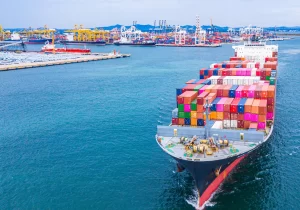
Global supply chains are entering a period of sustained volatility as geopolitical tensions, trade policy shifts and AI-driven industrial demand reshape the economics of sourcing and logistics. Organizations are rethinking network design, inventory strategies and supplier relationships to maintain resilience while protecting long-term profitability.
Cost Shock Replaces Cost Control
The latest Global Manufacturing Purchasing Managers’ Index from S&P Global shows factory output growing at the fastest pace since mid-2021, yet this apparent recovery masks severe strain in input flows. The index’s supplier delivery times measure registered its worst performance since 2022, indicating that lead times for materials into plants are stretching even as production ramps.
S&P Global links the bottlenecks directly to conflict in the Middle East, which is pushing up energy prices, disrupting shipping lanes and elevating insurance premiums along major trade corridors. The report warns that supplier delays are now adding upward pressure on prices at a time when inventories are already inflated by pre-buying in anticipation of shortages and cost increases.
Manufacturers used that stock build to support the April output surge, but S&P Global expects the effect to be short lived as warehouses clear and replenishment costs rise. The PMI commentary notes that extended supply chains typically take about six months to translate into higher consumer inflation, suggesting a pipeline of further price pressure already in motion.
Spencer Penn, chief executive of AI-enabled direct materials platform LightSource, describes 2026 as ‘just as turbulent, if not more so, than the start of the COVID era.’ He points to ocean freight rates up by around 150% and air cargo costs higher by roughly 40%, a swing that materially alters landed cost calculations for offshore sourcing strategies.
Trade policy is compounding the squeeze. A succession of U.S. tariff actions under multiple trade statutes has widened duties across a broad set of trading partners. Early on, many companies hesitated to reorganize networks in the belief that tariffs might be temporary. As duties persisted, they began to flow through into contract prices, bills of materials and consumer tags.
In this landscape, traditional cost-reduction tools such as lean inventories and just-in-time replenishment are losing traction. Many organizations are deliberately carrying extra stock to buffer against sudden transport disruption, new tariffs or renewed port congestion. The resulting working capital drag is becoming a structural feature of network design rather than a short-term anomaly.
AI Capacity Race Reshapes Industrial Demand
Beneath the immediate logistics and tariff issues, a deeper realignment of industrial demand is underway driven by rapid build-out of data centers and AI compute capacity. Penn notes that the scale of current AI infrastructure investment is ‘sucking all the air out of the room,’ with memory and related components seeing sharp price increases as capacity is diverted to digital infrastructure projects.
Capital market signals reinforce the shift. The valuation of leading space and AI-related firms now far exceeds that of many traditional industrial manufacturers, redirecting investor focus and, in turn, capital expenditure priorities. This gap reflects not only expectations for digital growth but also the pull of AI on upstream materials such as advanced semiconductors, specialty glass, fiber optics and high-performance batteries.
Some established manufacturers are already repurposing assets to follow this demand. Ford has begun using its automotive battery technology for stationary energy storage linked to AI data centers, illustrating how traction battery plants can be reoriented toward grid and compute applications. Corning, long known for device glass, is scaling plastics and fiber optic production that connect graphical processing units into high-density compute clusters.
These moves signal a broader pattern, production footprints and supplier portfolios originally optimized for automotive, consumer electronics or industrial equipment are being redrawn to serve digital infrastructure. For operations teams, this means more competition for critical inputs, tighter alignment between energy and technology supply chains and a more complex mix of customers vying for the same capacity.
As the AI build-out accelerates, suppliers are pricing in both cost volatility and demand certainty by resetting contract terms, shortening price validity windows and inserting more frequent renegotiation triggers. Penn observes that when cost swings show up quarter after quarter, procurement teams are forced back to raw input assumptions and must reopen agreements once treated as stable.
Adaptive Networks Will Strengthen Competitive Resilience
As volatility becomes a persistent feature of global trade, supply chain performance will increasingly depend on the ability to adapt sourcing, capacity and logistics decisions as conditions evolve. Organizations that combine diversified supplier networks, disciplined planning and continuous scenario analysis can respond more effectively to changing costs while preserving service levels and long-term operational resilience.