Shifting rules on sustainability reporting are creating uncertainty, but investors and regulators increasingly expect disclosures that can withstand audit-level scrutiny. Companies relying on modeled estimates and supplier self-reporting face rising compliance and reputational risks as certification becomes a practical requirement rather than a signaling tool.
Regulation Retreats But Scrutiny Rises
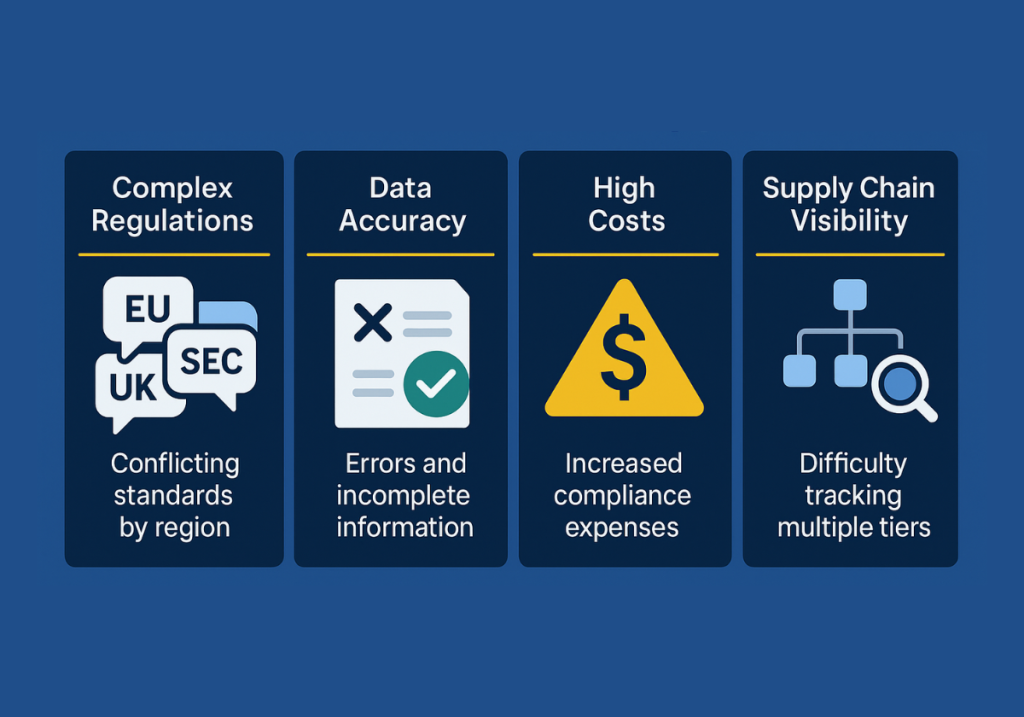
European officials have reportedly considered scaling back parts of the Corporate Sustainability Reporting Directive (CSRD), including how deeply companies must trace impacts across their supply chains. The move mirrors a broader pattern, some jurisdictions are advancing mandatory disclosures while others dilute them, leaving multinational organizations to navigate diverging rulebooks.
Yet despite softer legislative language, expectations are increasing elsewhere. Scope 3 emissions, forced labor risks, and supplier working conditions are being treated as central operational responsibilities, not side issues. Global standard-setting bodies, including the ISSB through IFRS S2, continue to push for comparable, decision-useful data that investors can trust. In the U.S., state-level rules and SEC climate-related disclosures are moving in parallel, even as federal scope remains contested.
The result is a confusing landscape: policy uncertainty on one side, rising stakeholder pressure on the other. Compliance teams face higher costs and the risk of inconsistent reporting, conditions that expose companies to reputational and regulatory blowback.
Certification Turns Claims Into Proof
Most sustainability reports still lean on modeled assumptions or spend-based calculations, particularly for Scope 3 categories such as logistics, materials, and upstream manufacturing. These methods are often acceptable during early measurement phases but are now viewed as insufficient when claims carry financial, legal, or investor implications.
Independent certification closes that gap. Standards including ISO 14001, ISO 45001, and SA8000 establish structured, auditable controls across emissions, worker protections, and social responsibility. Supply-chain-specific standards such as ISO 20400 and ISO 22301 reinforce procurement governance and continuity planning.
Verification matters not just for credibility but for operational resilience. Companies that validate supplier data reduce exposure to greenwashing accusations, audit failures, and market skepticism. Recent data shows investors increasingly challenge sustainability claims that lack traceable evidence, particularly in emissions-intensive sectors such as apparel, chemicals, and transportation.
Fragmented Standards Raise Structural Costs
Regulatory divergence forces companies to map multiple frameworks, CSRD in Europe, IFRS globally, GRI for voluntary reporting, and varying U.S. state policies. Large organizations report that inconsistent mandates drive up reporting costs by 20% to 30%, primarily due to duplicated data collection and re-verification across regions.
That friction is pushing companies toward consolidation using widely recognized baselines such as the GHG Protocol and ISO 14064, rather than custom models that cannot withstand third-party review. Targeted engagement with high-impact suppliers remains essential, as a small subset often accounts for the bulk of emissions or social risk.
At the same time, maturing programs are shifting from aggregated models to activity-level data feeds, meter-level energy tracking, material provenance systems, and digital chain-of-custody records, precursors to fully assured reporting.
When ESG Data Starts to Price Risk
Credit agencies and insurers are beginning to factor emissions transparency and labor practices into premium calculations and risk models, particularly in energy-intensive and commodity-based sectors. If verified ESG metrics become inputs to underwriting and credit scoring, not side disclosures, companies without audit-grade data could face higher financing costs rather than regulatory penalties alone.