BJ’s is reshaping its club supply chain by tightening discretionary inventory and embedding AI-driven robotics into clubs and distribution to protect margin while scaling omnichannel growth.
In Brief
- BJ’s has moved inventory risk upstream in general merchandise to fund price investment in core consumables under tariff uncertainty.
- Robotics and digital twins inside clubs now drive materially higher pick efficiency and in-stock performance with less inventory.
- An automated DC in Ohio and a fast-growing club network extend this model from single-site experiments to system-level design.
Why BJ’s Pushed Inventory Discipline Into The Foreground
BJ’s current year supply chain story starts with a deliberate constraint, not an expansion. Early in the year, leadership cut back buys in tariff-exposed general merchandise and seasonal categories, accepting softer revenue in those areas to avoid overstock and markdown risk while tariffs were in flux.
Management has been explicit that this was a trade: hold more conservative positions where style, seasonality and tariff exposure collide, and use the freed working capital and margin headroom to reinforce value in the staples that anchor membership economics. General merchandise and services still grew 1.8 percent on a comparable basis in the third quarter, but home and seasonal were called out as deliberate offsets due to inventory restraint.
At the same time, the company ended the quarter with total inventory down 1.5 percent year over year and per club inventory down 5 percent, while in-stock rates improved by 90 basis points. That was achieved with nine more clubs in the estate than a year ago. For an asset-light club model, this is the structural change that matters most: inventory is being treated as a portfolio risk lever across categories, not simply a function of top-line ambition.
In operational terms, this kind of shift requires a different planning cadence. Category managers and supply planners have to be willing to codify separate service targets, open-to-buy and markdown risk thresholds for staples, fresh food and discretionary general merchandise. It pushes more of the debate about tariff exposure, trend risk and capital allocation into pre-season planning rather than end-of-season cleanup.
How AI, Robotics And Digital Twins Are Changing Club Operations
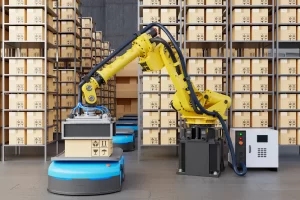
The second structural move is inside the clubs themselves. BJ’s has no traditional warehouse management systems in its large-format buildings, but it has been retrofitting similar capability through robotics and computer vision.
A shelf-scanning robot, Tally, originally deployed for inventory and price-line accuracy, now feeds imagery into digital twins of each club. Those twins underpin three execution layers:
- Automated detection of empty locations, misplaced items and pricing errors that generate task lists for in-club teams
- Quality spotting in fresh departments to surface risks before they appear as shrink
- Pick-path optimisation for click-and-collect and same-day delivery, improving picking efficiency by around 40 percent compared with prior processes
Well over 90 percent of digital orders are fulfilled by clubs, and digital mix is approaching 17 percent of total sales after 30 percent growth in the quarter and 61 percent on a two-year stack. Embedding pick logic and exception detection into robotics data is what allows that digital volume to be absorbed without a mirrored e-commerce DC network.
At network level, this is implemented through a feedback loop between shelf conditions and central planning. Robotics-derived shelf images feed into allocation and replenishment systems, which refine store-level demand profiles and safety stocks. Central planning in turn adjusts case-pack flows and DC-to-club assignments, narrowing the gap between book stock and physical reality without adding more stock into the system.
Peers in other segments are pursuing variants of this control model. A home improvement chain has used computer vision and mobile tools to lift on-shelf availability to record levels while freeing store labor, and a consumer electronics retailer now routes around 70 percent of online orders to the most efficient ship node via a data-driven sourcing engine. BJ’s approach is specific to a club format with no WMS, but the direction is similar: turning real-time, location-level data into a practical operating system for inventory and labor.
Why Inventory Risk Moved Upstream In General Merchandise
The decision to tighten general merchandise inventory in the face of tariff uncertainty is more than a one-off response to trade policy. It formalises category-level capital allocation in the operating model.
Home and seasonal are structurally high-risk for a warehouse club. Forecast error converts quickly into markdowns and write-offs because trend, color and event timing are difficult to call precisely, and the physical boxes are large. Tariff volatility compounds that by making landed cost less predictable. BJ’s response was to pull back on buys in those categories, even as it opened more clubs and grew overall merchandise comps by 1.8 percent.
From a supply chain perspective, that move requires:
- Clear separation of forecasting approaches for essentials versus fashion- and season-driven categories
- Shorter commitment windows and smaller test buys in home and seasonal, even if that means later full allocation once trends confirm
- Tighter collaboration between sourcing, planning and finance to decide how much capital can be tied up in long-lead discretionary inventory when tariffs are live issues
Other large retailers have navigated recent tariff rounds by leaning into vendor co-funding, origin shifts and selective ticket increases while holding price ladders in opening price points. BJ’s has used those tools, but its most visible lever is volume: less at-risk stock and more room to maintain price competitiveness where it matters most for member behaviour.
The constraint shows up in guidance. Management narrowed full-year merchandise comp expectations to 2–3 percent but raised adjusted EPS guidance to 4.30–4.40 dollars, highlighting that inventory discipline and operating efficiency are offsetting a softer discretionary curve.
What Club-based Fulfilment Now Looks Like At Scale
The combination of robotics, digital twins and a club-first fulfilment policy is pushing clubs into a hybrid role as both retail and light-fulfilment nodes.
Operationally, BJ’s omnichannel model now rests on three visible elements:
- BOPIC, same-day delivery and ExpressPay driving digital engagement and pushing more orders into back-of-club picking
- Club-based fulfilment for the vast majority of digital sales, supported by pick-path optimisation and better location data rather than separate fulfilment centres
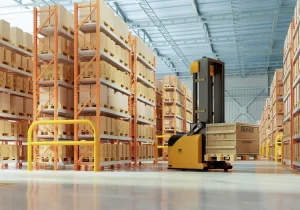
- A forthcoming highly automated distribution centre in Ohio, designed to operate almost entirely through robotics, feeding a growing number of clubs with higher throughput and accuracy
A 40 percent uplift in pick efficiency inside clubs is material in this context. It reduces labor hours per order and shortens cycle times, which becomes essential as digital penetration climbs. The automated Ohio DC is the upstream counterpart: concentrating mechanised handling and slotting at one node to support a network that is adding 14 clubs this year and plans 25–30 over two years.
For supply organisations, this shifts attention from building new infrastructure to orchestrating flows through existing assets more intelligently. System architecture has to stitch together club-level digital twins, master data on product locations, a planning system that respects category-level risk rules, and a transport layer that connects the robotic DC to a geographically expanding club network.
Constraints, Trade-offs and Execution Friction
The model is not without limits. Club-based fulfilment assumes that product is physically where systems believe it is, and that in-club teams can absorb both retail tasks and growing fulfilment workloads. Robotics and automated task lists help, but they also create a dependency on uptime and data quality that did not exist when audits were manual and slower.
The highly automated DC in Ohio will concentrate capacity and risk. It promises higher productivity than a traditional site, but any technology outage or integration issue could have a disproportionate impact on flow. Resilience planning must therefore extend beyond traditional weather and port scenarios to include automation failure modes.
On inventory, deliberate tightness in home and seasonal reduces markdown risk but caps upside if discretionary demand recovers faster than expected. Reaccelerating those categories would require faster vendor lead times, more flexible sourcing contracts and potentially different SKU policies to keep trend risk manageable.
There is also a balancing act between digital growth and delivery economics. BJ’s has reduced delivery fees to make its most convenient channels more accessible, trading some near-term cost-to-serve for digital adoption and share-of-wallet. Flat merchandise gross margin rates ex fuel, despite this investment, suggest that automation, better allocation and growing ancillary revenue streams such as retail media are currently offsetting that pressure. Whether that balance holds as digital exceeds one-fifth of sales will depend on continued gains in pick efficiency and inventory productivity.
What BJ’s Operating Model Now Enables
Taken together, BJ’s inventory tightening and AI-led robotics push mark a clear shift in how the company runs its supply chain. Inventory is being governed at category level with explicit risk and capital trade-offs, robotics are providing a de facto warehouse management layer inside clubs, and a new automated DC is set to extend that logic upstream.
The result is a club network that can support double-digit digital growth, higher in-stock levels and an expanding physical footprint while holding merchandise margin steady and investing in member value. The operating model now gives BJ’s more control over where it takes risk, where it deploys capital and how it converts physical assets into fulfilment capacity, which is likely to be a defining capability as tariffs, consumer budgets and channel mix continue to move.