AI in warehouses is spreading across scheduling, forecasting, and floor-level decision support, yet many facilities lack the skills depth to use these tools fully. New labor-market analysis highlights a widening divide between AI investment and workforce readiness that is reshaping cost, risk, and execution.
AI Spreads Faster Than Skills Can Follow
Artificial intelligence is increasingly woven into daily tasks in logistics facilities, from shift planning and inventory allocation to order promising and carrier selection. Job-posting data analyzed by Resume Now, using Lightcast labor-market information, places logistics and warehousing among the top four industries with the largest mismatch between AI usage and employee preparedness heading into 2026. The study tracks where employers are asking for AI-related capabilities faster than the labor pool can respond.
That strain is most visible in environments with large frontline teams. Distribution centers and fulfillment hubs lean on AI-enabled warehouse and execution systems, predictive labor planning engines, and optimization tools that recommend work sequences in real time. SAP Extended Warehouse Management, for example, includes machine-learning features for predictive labor demand planning that mine historical pick and pack data to forecast workload and staffing needs, giving supervisors algorithmic input on how to schedule shifts and position resources.
As these systems spread, enablement capacity is emerging as a hard boundary. Resume Now highlights three recurring effects when AI readiness falls short: rising training budgets to retrofit existing staff with new skills, slower stabilization of new tools because workflows and governance lag the technology, and higher turnover among workers who feel exposed or underprepared. Tight hiring conditions for experienced operators, inventory specialists, and front-line leaders magnify these issues and increase the risk of disruption.
Independent research on AI-enabled warehouses highlights the payoff when implementations land well. Recent transformation studies report efficiency gains in the mid-twenties percent range, with comparable uplift in employee productivity and resilience when predictive analytics spot volume swings or supply interruptions early. Facilities that pair AI with real-time sensor and RFID data often achieve faster cycle times, fewer stockouts, and more accurate order fulfillment. The constraint is no longer the existence of tools but the ability of people to translate system recommendations into consistent practice.
Training as Core Architecture For AI-enabled Warehouses
The readiness findings recast AI programs in warehouses as workforce architecture decisions rather than pure technology projects. When optimization engines, robotics, and forecasting models appear on the floor without structured preparation, employees head into each shift decoding system behavior by trial and error. That dynamic slows decisions, erodes trust in algorithmic output, and sends supervisors back to manual workarounds and spreadsheets.
Readiness gaps also alter the true economics of AI. Investments that appear attractive on software, automation, and infrastructure lines can lose their edge once recurring training, lost hours during classroom time, and rework from incorrect use are factored in. Resume Now notes that in many workplaces the expectation falls on individuals to self-teach new tools, often off the clock. That approach can suppress near-term costs yet drive disengagement and churn in roles where alternative employment in transportation, construction, or manufacturing is readily available.
Evidence from more mature digital warehouse programs points to a different pattern when skills are built into design. Facilities that define new job profiles around AI-enabled decision-making, run targeted upskilling for planners, supervisors, and operators, and embed human override rules into standard work usually reach steady-state performance faster. Vendor benchmarks indicate that predictive labor planning performs best when shift managers receive explicit training on reading forecasts, pressure-testing scenarios, and aligning staffing moves with commercial priorities rather than treating algorithmic output as a static report.
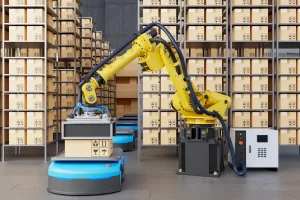
Robotics adoption follows a similar arc. Studies of AI-guided picking and sortation systems show that robots can lift batch pick rates by roughly one-third and increase sortation throughput by several multiples, provided humans understand how to coordinate with machines, interpret prompts, and handle exceptions. Where that understanding is thin, automation runs below planned utilization and becomes a visible friction point on the floor.
The Quiet Bottleneck In AI Warehouse Strategy
The latest labor-market analysis exposes a quieter constraint inside AI-heavy warehouse programs: the rate at which large, distributed teams can internalize new decision logic and new ways of working. As more facilities roll out predictive planning, dynamic slotting, and algorithmic tasking, organizations that treat training as a standing capability, funded and governed like any core system, are likely to pull ahead. Early trade data already points to widening differences in fulfillment speed, error rates, and labor stability between networks that approach AI as a full operating-model shift and those that frame it as a software add-on.