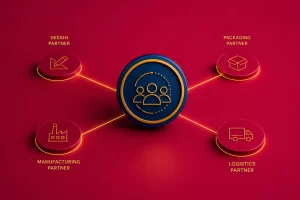
While competitors race to build faster AI chips, NVIDIA has built something even harder to replicate: a supply chain designed around strategic partnerships, long-term capacity planning and disciplined execution.
NVIDIA’s biggest advantage isn’t its technology
NVIDIA’s leadership in AI is often attributed to its industry-leading GPUs. But its greatest competitive advantage lies somewhere less visible: a supply chain designed to secure critical capacity, coordinate specialist partners and scale faster than competitors.
Success in today’s semiconductor industry depends on far more than product innovation. It requires long-term capacity planning, deep supplier collaboration and an operating model capable of navigating one of the world’s most complex and supply-constrained manufacturing environments.
This article explores the strategic capabilities behind NVIDIA’s supply chain, from ecosystem partnerships and integrated planning to supplier collaboration and supply chain orchestration, and the practical lessons organisations can apply to strengthen resilience, improve decision-making and build more competitive operations.
Unlike traditional manufacturers, NVIDIA owns very little of the physical infrastructure required to produce its products. Instead, it has built an operating model that combines strategic procurement, long-term supplier partnerships and integrated planning into a supply chain that competitors struggle to replicate.
The strength of that approach is reflected in Gartner’s 2026 Global Supply Chain Top 25, where NVIDIA was ranked as the world’s second-leading supply chain.
An operating model built around partnerships
NVIDIA’s supply chain begins with a deliberate strategic decision: remain fabless.
Rather than investing tens of billions of dollars in semiconductor fabrication plants, the company focuses on chip architecture, software and product development while relying on specialist partners for manufacturing, packaging, testing and assembly.
Its most important manufacturing relationship is with Taiwan Semiconductor Manufacturing Company (TSMC), which produces NVIDIA’s advanced GPUs using leading-edge process technologies. Other critical partners contribute high-bandwidth memory, advanced packaging, server integration and testing, creating an interconnected ecosystem rather than a traditional linear supply chain.
This approach allows NVIDIA to access world-class manufacturing capabilities without carrying the capital burden of owning fabrication facilities. It also gives the company flexibility to scale production as AI demand accelerates.
The trade-off, however, is dependence on external partners. Success therefore relies not on ownership but on the strength of supplier relationships, governance and long-term planning.
Why it matters
Many organisations continue to view outsourcing primarily as a cost decision. NVIDIA demonstrates that, when managed strategically, partnerships can become a source of innovation, flexibility and competitive advantage rather than simply an operational necessity.
Capacity became the competitive battleground
For many manufacturers, procurement focuses on securing materials at the best commercial terms. In NVIDIA’s world, the scarce resource is manufacturing capacity itself.
Advanced AI processors rely on highly specialised technologies such as cutting-edge wafer fabrication, high-bandwidth memory (HBM) and advanced packaging processes like Chip-on-Wafer-on-Substrate (CoWoS). These capabilities are concentrated among a small number of suppliers, making capacity one of the industry’s most constrained assets.
Rather than waiting for demand to materialise, NVIDIA reportedly secured significant CoWoS packaging capacity years in advance, enabling it to support the explosive growth in AI infrastructure while competitors faced production bottlenecks.
Industry analysts estimate that advanced chip packaging capacity remained one of the key constraints on AI server production throughout 2024, illustrating how manufacturing capability—not customer demand—became the limiting factor.
This reflects a broader shift in supply chain strategy. In highly constrained markets, the ability to secure future capacity can be more valuable than negotiating lower purchase prices.
Why it matters
As supply chains become increasingly capacity constrained, procurement and planning teams need to think beyond unit cost. Long-term access to strategic capabilities may become one of the most important sources of competitive advantage.
Strategic suppliers became an extension of the business
NVIDIA’s supplier network operates less like a collection of vendors and more like an integrated ecosystem.
Its relationships extend beyond transactional purchasing into collaborative planning, technology development and capacity investment. Foundries, memory suppliers, packaging specialists, server manufacturers and cloud infrastructure providers all contribute to delivering AI systems at scale.
This level of collaboration enables suppliers to align investment decisions with NVIDIA’s long-term product roadmap while giving NVIDIA greater visibility into future manufacturing capabilities.
The result is a supply network capable of responding more effectively to rapid shifts in demand than one built solely on short-term purchasing agreements.
Building these relationships takes years. Trust, transparency and shared planning become just as important as contractual terms.
Why it matters
The most valuable supplier relationships increasingly involve joint problem-solving, shared investment and long-term alignment. Organisations that continue to manage strategic suppliers primarily through procurement metrics alone may struggle to unlock the full value of these partnerships.
Planning years ahead rather than reacting to demand
The AI market is characterised by extraordinary demand volatility, long manufacturing lead times and constrained supply.
In this environment, reactive planning is insufficient. NVIDIA aligns product roadmaps, supplier capacity, manufacturing schedules and customer demand over multi-year horizons. Large cloud providers, including Microsoft, Amazon, Google and Meta, make substantial infrastructure investments well before new AI platforms are deployed, creating greater visibility into future demand.
This longer planning horizon enables NVIDIA and its partners to make coordinated capacity decisions before shortages emerge.
Increasingly, NVIDIA also applies its own AI technologies to supply chain optimisation. Tools such as NVIDIA cuOpt and Omniverse support scenario modelling, optimisation and digital simulation, allowing planners to evaluate multiple supply chain scenarios more rapidly than traditional approaches.
While no planning process eliminates uncertainty, better visibility enables faster and more informed decision-making.
Why it matters
Integrated planning is evolving from a forecasting exercise into a strategic capability. Organisations that combine demand signals, supplier collaboration and scenario planning are better positioned to respond to disruption without compromising service or growth.
Resilience comes from orchestration, not ownership
NVIDIA’s supply chain remains exposed to significant risks.
Advanced semiconductor manufacturing is geographically concentrated, geopolitical tensions continue to reshape global trade policies and export controls have required the company to adapt products for different markets. At the same time, shortages in advanced packaging and memory technologies have created ongoing supply constraints.
Rather than attempting to eliminate every risk through ownership, NVIDIA focuses on orchestration. Strong governance, close supplier collaboration, diversified specialist partners and continuous planning help the company respond more effectively as conditions change.
Resilience, in this context, is less about removing uncertainty than about improving the organisation’s ability to adapt.
Why it matters
Resilient supply chains are rarely the ones with the most assets. More often, they are the ones that can coordinate partners, share information and make high-quality decisions quickly when disruption occurs.
The advantage competitors cannot easily replicate
Many companies can invest in semiconductor design. Far fewer can replicate the ecosystem that enables NVIDIA to deliver products at scale.
Its advantage has been built over years through trusted supplier relationships, disciplined capacity planning, integrated governance and a willingness to treat supply chain strategy as a source of competitive differentiation rather than operational support.
These capabilities are difficult to acquire quickly because they depend on relationships, execution and organisational discipline as much as technology.
As AI continues to reshape industries, NVIDIA offers a timely reminder that supply chains are no longer simply responsible for moving products efficiently. Increasingly, they determine which organisations can turn innovation into commercial success.
Applying the lessons
Few organisations operate in markets as technologically complex as semiconductor manufacturing, but the underlying principles are widely applicable.
Supply chain leaders looking to strengthen their own operations can take several practical lessons from NVIDIA’s approach:
- Identify which suppliers are truly strategic and invest in deeper collaboration beyond transactional purchasing.
- Treat capacity as a strategic resource, particularly where supply constraints are likely to emerge.
- Extend planning horizons by integrating demand, sourcing and manufacturing decisions earlier in the product lifecycle.
- Build governance that supports joint decision-making across internal teams and key external partners.
- View supply chain as a driver of competitive advantage, not simply a function focused on efficiency and cost.
In an increasingly uncertain operating environment, organisations that can orchestrate complex partner ecosystems, anticipate constraints and make faster strategic decisions will be better positioned to compete. NVIDIA’s experience shows that the most enduring advantage may not come from owning more assets, but from building a supply chain that others simply cannot replicate.