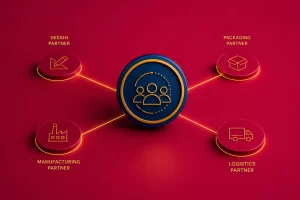
Long before an AI chip reaches production, NVIDIA has already made many of the decisions that determine its success. By anticipating supply constraints, strengthening strategic partnerships and planning years ahead, the company has built a supply chain that can scale with demand rather than react to it.
The AI race is won long before production begins
When people think about NVIDIA’s competitive advantage, they usually focus on the performance of its GPUs or the rapid growth of artificial intelligence. Yet one of the company’s greatest strengths is far less visible.
By the time an NVIDIA AI processor enters production, years of planning, supplier collaboration and strategic decision-making have already taken place. Manufacturing capacity has been secured, critical suppliers have aligned investment plans, product roadmaps have been shared across the ecosystem and future demand has been modelled well in advance.
This approach reflects a broader shift in modern supply chain management. Competitive advantage is no longer created solely through efficient execution. Increasingly, it comes from making better decisions earlier than competitors.
For organisations operating in uncertain markets, NVIDIA demonstrates that the most valuable supply chain capability may not be speed. It is preparedness.
How does NVIDIA prepare for demand before it exists?
Demand for AI infrastructure has expanded at an unprecedented pace, but semiconductor manufacturing cannot respond overnight.
Building advanced fabrication capacity, expanding high-bandwidth memory production or increasing advanced packaging capability all require years of investment. Waiting until demand appears is simply too late.
Rather than reacting to market signals, NVIDIA works with strategic partners to anticipate future requirements. Product roadmaps, customer demand and manufacturing capabilities are considered together, allowing investment decisions to be made well before production begins.
This forward-looking approach helped position NVIDIA to respond as generative AI adoption accelerated across cloud providers and enterprise customers. Preparing for demand before it becomes visible has become one of the company’s defining competitive advantages.
Why is early capacity planning becoming a competitive advantage?
In many industries, supply chain planning focuses on balancing inventory with short-term demand forecasts. The semiconductor industry operates differently.
The most valuable resource is often not inventory but manufacturing capacity itself. Advanced wafer fabrication, CoWoS packaging and HBM memory are all limited by specialist production capabilities that cannot be expanded quickly.
Recognising these constraints, NVIDIA reportedly secured significant advanced packaging capacity years ahead of the AI boom. While competitors struggled to obtain sufficient manufacturing capacity, NVIDIA had already aligned much of its future production with supplier investments.
Capacity planning therefore becomes much more than an operational scheduling exercise. It becomes a strategic decision about future growth.
As industries face increasing supply constraints, from critical minerals to specialised manufacturing, this way of thinking is becoming relevant far beyond semiconductors.
How does NVIDIA connect strategy with supply chain execution?
One of the biggest challenges for global organisations is translating long-term business strategy into day-to-day operational decisions.
NVIDIA reduces this gap by aligning product development, customer demand, manufacturing capability and supplier investment through integrated planning.
Large cloud providers often commit significant infrastructure investment well before AI platforms are deployed. These demand signals provide NVIDIA with greater confidence to coordinate production planning with manufacturing partners months or even years in advance.
Instead of individual functions making isolated decisions, planning becomes a cross-functional process connecting engineering, procurement, manufacturing and commercial teams.
The result is a supply chain that responds proactively rather than reactively.
How does AI improve supply chain planning?
NVIDIA is not only supplying AI technology to customers. It is also applying AI to improve its own operations.
Technologies such as NVIDIA Omniverse and cuOpt enable digital simulation, scenario analysis and optimisation across supply chain networks. Planners can evaluate multiple supply scenarios, identify emerging bottlenecks and assess alternative decisions before operational issues arise.
AI does not replace supply chain expertise. Instead, it augments human decision-making by providing faster analysis across increasingly complex networks.
This reflects a wider trend identified by Gartner’s 2026 Supply Chain Top 25, where leading organisations are using AI not simply to automate existing processes but to redesign how planning and decision-making are performed.
Why does preparation reduce disruption?
Supply chain resilience is often associated with responding effectively when disruption occurs.
NVIDIA’s approach focuses on reducing disruption before it happens.
Early planning, long-term supplier collaboration and continuous visibility help identify risks while there is still time to act. Whether managing geopolitical uncertainty, manufacturing bottlenecks or rapid shifts in AI demand, the company is able to make strategic adjustments before operational execution is affected.
Preparation does not eliminate uncertainty, but it provides organisations with greater flexibility when conditions inevitably change. This proactive mindset increasingly distinguishes leading supply chains from those that spend most of their time responding to crises.
What can supply chain leaders learn from NVIDIA?
NVIDIA’s success illustrates that supply chain performance begins long before production starts. The organisations that consistently outperform are often those that make strategic decisions earlier, collaborate more closely with partners and align planning with long-term business objectives.
While few businesses operate in the semiconductor industry, the underlying principles are widely transferable.
Supply chain leaders can strengthen their own operations by:
- Planning capacity alongside business growth, rather than waiting for demand to materialise.
- Integrating procurement, planning and manufacturing into a single strategic decision-making process.
- Using AI and digital tools to improve scenario planning and identify constraints earlier.
- Sharing longer-term forecasts with strategic suppliers to support joint investment and capacity planning.
- Viewing preparedness as a competitive capability, recognising that many operational challenges can be mitigated through earlier planning.
As supply chains become more interconnected and uncertainty continues to grow, competitive advantage will increasingly belong to organisations that prepare before markets change rather than those that react after disruption occurs. NVIDIA’s experience demonstrates that some of the most important supply chain decisions are made long before the first product reaches the factory floor.