Modern retail is no longer defined by what happens inside a store. Increasingly, competitive advantage depends on how efficiently inventory moves from distribution networks to customers’ doorsteps. Walmart’s ongoing experiments with dark stores illustrate how large retailers are rethinking fulfillment strategies to meet rising expectations for faster delivery while controlling operational costs. More importantly, these facilities highlight broader questions about inventory visibility, network design, and the economics of omnichannel retail.
Executive Summary
As online grocery and general merchandise sales continue to reshape retail operations, the idea of a Walmart dark store has become an important topic across the supply chain industry. Unlike traditional retail locations, dark stores are closed to walk in customers and are dedicated exclusively to fulfilling online orders.
While Walmart testing dark stores has attracted significant attention, the broader story is not simply about another fulfillment model. It reflects a strategic effort to improve inventory productivity, shorten delivery times, and reduce the operational friction created when stores simultaneously serve in person shoppers and online customers.
This article examines what a Walmart dark store is, why Walmart is testing dark stores, how dark stores compare with stores and fulfillment centers, and what these experiments could mean for inventory management and last mile delivery in the years ahead.
Why Walmart Is Rethinking Retail Fulfillment?
The retail landscape has fundamentally changed over the past decade. Customers increasingly expect same day or next day delivery across groceries, household essentials, electronics, and general merchandise. Meeting those expectations consistently requires more than simply expanding e commerce capacity. It requires redesigning how inventory flows through an entire network.
Traditional stores were never built to support thousands of online orders alongside daily customer traffic. Store associates picking products from crowded aisles can create congestion, affect shelf availability, and reduce the shopping experience for customers visiting the store. At the same time, fulfillment centers located farther from population centers often increase transportation costs and delivery times.
This challenge explains why industry interest in Walmart dark stores online delivery continues to grow. Instead of asking stores to perform two very different jobs, retailers are evaluating whether dedicated fulfillment locations can improve both operational efficiency and customer service.
Dark stores sit between a conventional store and a distribution center. They resemble supermarkets from the inside, but every aisle, process, and employee is focused entirely on online order fulfillment. That distinction is operationally significant. Inventory can be organized for faster picking, replenishment becomes more predictable, and layouts can be optimized around productivity instead of customer browsing behavior.
The result is not merely faster order preparation. It creates an opportunity to rethink inventory deployment across an entire retail network.
What Is a Walmart Dark Store and Why Is Walmart Testing the Model?
A common question emerging across search engines is what is a Walmart dark store?
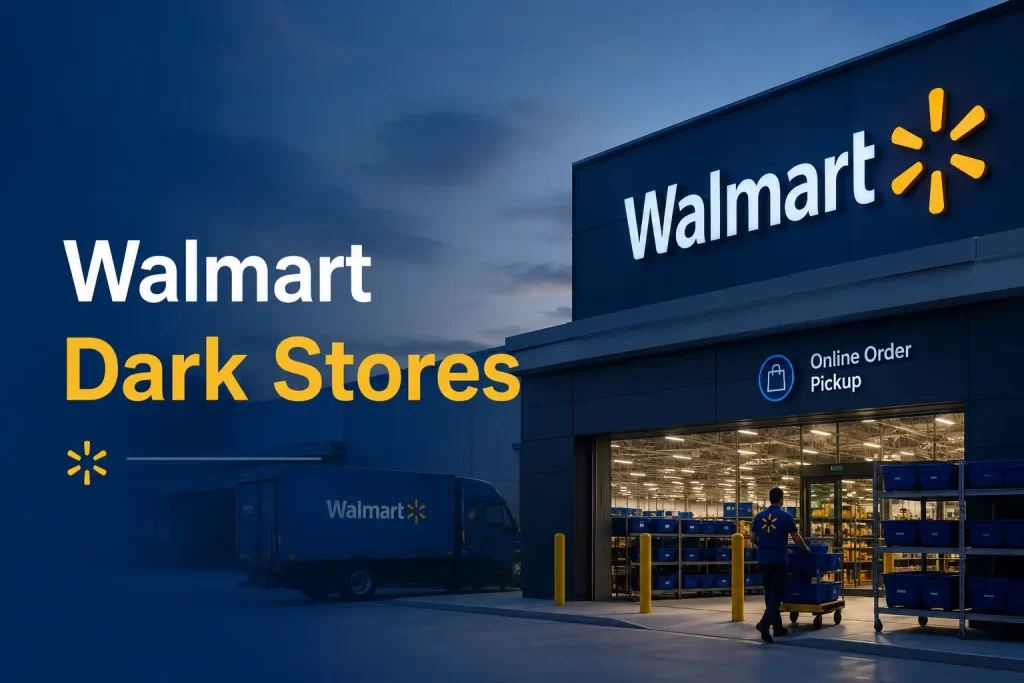
A Walmart dark store is a retail facility that is closed to public shopping and dedicated exclusively to preparing online pickup and delivery orders. From the outside, the building may resemble a conventional Walmart location, but internally it functions as a high speed fulfillment operation rather than a customer facing retail environment.
Unlike automated fulfillment centers designed primarily for pallet handling and large inventory movements, dark stores focus on assembling individual customer orders quickly and accurately.
The concept itself is not new. Grocery retailers in several markets have experimented with dark stores for years. What makes Walmart’s approach particularly noteworthy is its scale, existing store footprint, and ability to integrate these facilities into a much larger omnichannel ecosystem.
Recent industry reporting indicates that Walmart testing dark stores is less about replacing existing stores and more about understanding where dedicated fulfillment creates measurable operational advantages.
That distinction matters. Many headlines have prompted questions such as Is Walmart going online only? The evidence suggests otherwise.
Physical stores remain central to Walmart’s business model because they support multiple revenue streams, including walk in shopping, pickup, pharmacy, financial services, and local inventory positioning. Rather than eliminating stores, dark stores are being evaluated as complementary assets that can relieve pressure on high volume locations where online demand has outgrown existing operational capacity.
This is a far more nuanced strategy than simply expanding e commerce.
Instead, Walmart appears to be asking several practical questions.
- Can dedicated fulfillment sites reduce order assembly time?
- Can inventory accuracy improve when customers are no longer shopping from the same shelves?
- Can labor productivity increase through optimized picking paths?
- Can delivery routes become shorter when inventory is positioned closer to demand?
These questions extend beyond Walmart. Every retailer balancing store operations with online fulfillment faces similar trade offs. Perhaps the most overlooked aspect of the discussion is labor.
Store based fulfillment often requires associates to interrupt merchandising, shelf replenishment, and customer assistance in order to fulfill online orders. As digital volumes increase, these competing priorities become increasingly difficult to manage.
Dark stores remove much of that operational conflict. Employees work within an environment specifically designed for picking efficiency, allowing workflows to become more standardized and potentially easier to automate over time.
This does not necessarily mean lower labor requirements. Rather, it shifts labor toward specialized fulfillment processes that are easier to measure, improve, and integrate with technology such as automated storage systems, intelligent picking software, and real time inventory management.
Another important consideration is forecasting. Dedicated fulfillment facilities can create clearer demand signals because inventory movements are driven exclusively by digital orders. That visibility supports better replenishment planning, inventory allocation, and transportation scheduling.
For retailers operating large omnichannel networks, this level of inventory precision may ultimately prove more valuable than simply delivering orders a few hours faster.
The conversation around Walmart dark stores delivery fulfillment therefore extends well beyond customer convenience. It represents an operational experiment in building more responsive supply chains where inventory, labor, automation, and transportation are increasingly orchestrated as a single connected system.
The Operational Trade Offs Behind Walmart Dark Stores Delivery Fulfillment
While the benefits of dedicated fulfillment facilities appear compelling, dark stores are not a universal solution. Their success depends on local demand density, delivery economics, labor availability, and the retailer’s existing store network. This is why the conversation around Walmart dark stores delivery test is more significant than many headlines suggest. The emphasis is on testing, measuring, and refining rather than committing to a single operating model.
One of the biggest advantages of a dark store is improved picking efficiency. In a traditional retail environment, employees navigate around customers, promotional displays, and constantly changing shelf conditions. In a dark store, aisles can be redesigned solely for operational performance. Products with high online demand can be positioned closer together, travel distances can be reduced, and inventory replenishment can follow predictable schedules.
These seemingly small improvements compound over thousands of daily orders. Faster picking reduces labor costs per order while improving delivery speed and order accuracy.
Inventory visibility also improves. Traditional stores often struggle with inventory discrepancies because products are simultaneously being purchased in person and reserved online. A customer may order an item that appears to be available, only to discover it has already been taken from the shelf. Dedicated fulfillment locations reduce this conflict because inventory is allocated exclusively to digital orders.
That said, dark stores introduce new complexities.
Unlike conventional stores, they generate no revenue from walk in traffic. Every square foot must justify itself through fulfillment productivity and delivery efficiency. If online demand falls below expectations, fixed operating costs can quickly outweigh the benefits.
This makes network planning more important than the facility itself. Retailers must determine which locations should remain customer facing, which can support store based fulfillment, and where dedicated dark stores provide the strongest economic case. A one size fits all approach rarely succeeds because urban, suburban, and regional markets exhibit very different purchasing behaviors and delivery costs.
Another practical consideration is transportation. A faster picking process does not automatically translate into a better customer experience if delivery routes remain inefficient. The real value of dark stores emerges when inventory placement, carrier capacity, and last mile routing are optimized together. Without that coordination, retailers risk shifting bottlenecks from the store to the transportation network.
Automation adds another layer to the equation. Recent investments across the retail industry show increasing interest in automated storage systems, robotics, and AI driven inventory management. Dark stores provide an environment where these technologies can be deployed more effectively than in customer facing stores because layouts are designed for operational consistency rather than shopper experience.
However, technology alone is rarely the differentiator. Many retailers have discovered that poor inventory data, inconsistent replenishment practices, or fragmented planning processes can undermine even the most advanced automation initiatives. Operational discipline remains the foundation of successful fulfillment.
What Walmart’s Dark Store Strategy Means for the Wider Supply Chain
The broader significance of Walmart’s experiments lies in what they reveal about the future of retail operations.
The industry is moving away from viewing stores, fulfillment centers, and distribution centers as separate assets. Increasingly, each facility plays a different role within a connected fulfillment ecosystem. Some stores will continue serving customers directly while also supporting pickup. Others may function as local fulfillment hubs, and selected locations may evolve into dedicated dark stores where digital demand justifies specialized operations.
This flexible network approach is becoming increasingly important as retailers balance service expectations with cost pressures.
One lesson from recent retail trends is that faster delivery is not always the ultimate objective. The greater competitive advantage often comes from delivering predictability. Reliable inventory availability, accurate delivery commitments, and consistent execution build customer trust more effectively than promising the shortest possible delivery window.
This perspective also answers another frequently searched question: Is Walmart going online only?
The evidence suggests the opposite. Retailers continue investing heavily in physical infrastructure, but those assets are being redefined. Stores are no longer viewed solely as places where customers browse products. They are becoming strategic nodes that support inventory positioning, local fulfillment, returns processing, and omnichannel services.
Dark stores represent one possible extension of that evolution rather than a replacement for brick and mortar retail.
Perhaps the most valuable takeaway from Walmart’s approach is its willingness to test before scaling. Retail history is filled with examples of companies rolling out ambitious network strategies only to reverse course when operating costs exceeded expectations. By treating dark stores as an operational experiment, Walmart gains the opportunity to measure labor productivity, transportation efficiency, inventory utilization, and customer satisfaction before making larger network decisions.
That disciplined approach offers an important lesson for organizations across the supply chain. New fulfillment models should not be evaluated solely on delivery speed. They should be measured against broader performance indicators, including inventory turns, cost to serve, labor productivity, capacity utilization, and overall network resilience.
Frequently Asked Questions
- What is a Walmart dark store?
A Walmart dark store is a retail location that is closed to public shoppers and dedicated entirely to fulfilling online pickup and delivery orders. It combines elements of a traditional store and a fulfillment center to improve order picking efficiency and inventory management.
- Why is Walmart testing dark stores?
Walmart is testing dark stores to evaluate whether dedicated fulfillment facilities can improve delivery speed, inventory accuracy, labor productivity, and overall omnichannel operations without disrupting in store shopping.
- How do Walmart dark stores support online delivery?
Dark stores allow employees to pick and pack customer orders in an environment designed specifically for fulfillment. This reduces congestion in retail stores, improves order accuracy, and helps accelerate delivery preparation.
- Are dark stores replacing Walmart stores?
No. Current initiatives suggest dark stores are intended to complement existing retail locations rather than replace them. Physical stores continue to play a critical role in pickup services, customer shopping, and local inventory availability.
- What can other retailers learn from Walmart’s delivery fulfillment strategy?
The biggest lesson is that fulfillment success depends on network design rather than any single facility type. Retailers should evaluate inventory placement, transportation, labor, automation, and customer demand together before expanding dedicated fulfillment operations.
The Bigger Question is Not About Dark Stores
The discussion surrounding Walmart dark stores is ultimately about something much larger than one fulfillment format. Retailers are entering an era where competitive advantage will come from orchestrating inventory, labor, automation, and transportation as a connected system rather than optimizing each function independently.
Dark stores may become a permanent feature in some markets and unnecessary in others. Their long term value will depend less on the buildings themselves and more on how effectively they fit within a broader fulfillment strategy. The organizations that succeed will be those that treat every operational experiment as an opportunity to build a more adaptable network, where inventory is positioned closer to demand, decisions are informed by real time data, and flexibility becomes as valuable as scale.