Agentic AI, systems designed to act autonomously within defined boundaries, has become one of the most closely watched technology developments in 2026. While adoption has so far been uneven, a new IEEE study suggests expectations among senior technologists are converging around a near-term expansion into everyday workflows, particularly in task coordination, data monitoring, and automation support.
The survey, part of IEEE’s Impact of Technology in 2026 and Beyond research, polled 400 CIOs, CTOs, and IT directors from large organizations across six countries. Nearly all respondents said innovation in agentic AI is advancing rapidly, driven by sustained investment from both established technology providers and startups.
From Experimental Tools To Practical Assistants
Respondents anticipate agentic AI evolving into a general-purpose “smart assistant” layer rather than a standalone application category. More than half expect AI systems to handle routine scheduling and calendar management tasks, while others foresee growing use in monitoring personal or organizational data, managing privacy controls, and tracking health or performance metrics.
The emphasis across responses is not full autonomy, but delegated execution. Agentic systems are expected to operate independently within clearly defined scopes, escalating decisions or exceptions to humans when thresholds are reached. That design model aligns with how many enterprises are already approaching AI deployment: incremental automation of bounded tasks rather than wholesale process replacement.
This shift is also reshaping workforce requirements. Survey participants identified AI ethics, data analysis, machine learning, and data modeling as among the most in-demand skills for 2026, reflecting the need to supervise, validate, and refine AI-driven decisions rather than simply build models.
Robotics, Logistics, and Uneven Readiness
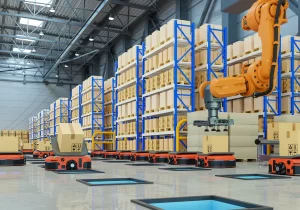
Beyond digital workflows, respondents expect AI’s influence to extend further into physical operations. A majority believe robotics will become more embedded in workplaces, with AI increasingly shaping how machines coordinate tasks, navigate environments, and interact with human workers. Autonomous vehicles, extended reality tools, and robotics were all cited as areas likely to see meaningful AI-driven change in 2026.
In logistics and supply chain operations, 35% of technology leaders said AI is likely to improve warehouse and automation efficiency in the near term. However, the survey also highlights a growing constraint: infrastructure. Nearly half of respondents believe it will take five to seven years to build sufficient data center capacity to support projected AI demand, underscoring a widening gap between software ambition and physical readiness.
Governance approaches remain fragmented. While nearly half of leaders said their organizations plan to move ahead aggressively with AI adoption, many intend to align policies with government regulations only as those rules emerge. Others are developing internal guidelines independently, suggesting that enterprise AI governance in 2026 will remain inconsistent across regions and sectors.
Where Agentic AI Will Quietly Succeed First
One overlooked signal in recent deployment patterns is that agentic AI is proving most durable when it is constrained, auditable, and tied to existing accountability structures. Systems that manage bounded tasks, scheduling within fixed rules, monitoring defined data sets, escalating only when thresholds are breached, are scaling faster than more ambitious, open-ended agents. That is not a limitation of the technology; it reflects how organizations absorb operational change. The near-term payoff from agentic AI is likely to come less from headline-grabbing autonomy and more from institutionalizing small, repeatable decisions in places where human oversight is already clear. That discipline, rather than model sophistication, is what will determine which deployments persist into 2027 and beyond.