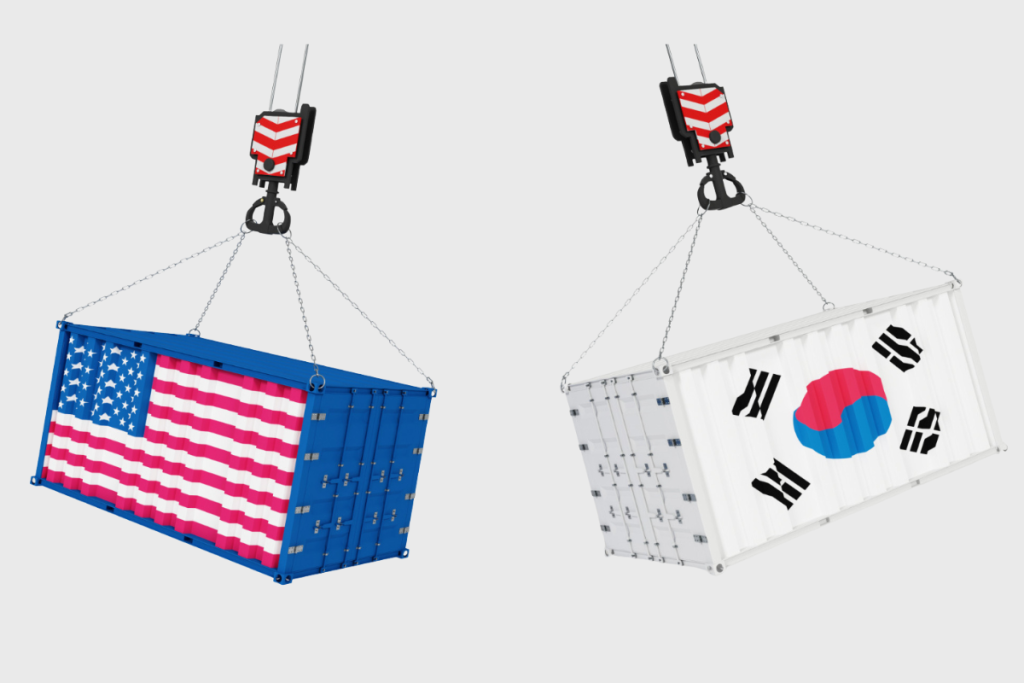
Washington and Seoul appear close to sealing a trade accord that would lower U.S. tariffs and reinforce South Korea’s investment push into American manufacturing. The talks, unfolding alongside broader diplomatic outreach across Asia, reflect a recalibrated U.S. strategy that pairs market access with domestic industrial commitments. A formal announcement could shift expectations for other regional negotiations now gathering pace.
Deal Advances With Tariff Concessions and Investment Commitments
The United States and South Korea have “pretty much finalized” a trade agreement, President Donald Trump said during a Wednesday dinner alongside South Korean President Lee Jae Myung in Gyeongju. While neither government has released signed documents, remarks from both sides suggest the deal builds on a July framework under which Washington agreed to reduce tariffs on South Korean imports from 25% to 15%. At that time, South Korea signaled plans to invest $350 billion in the U.S., with officials emphasizing semiconductor capacity, electric-vehicle supply chains, and critical-materials projects.
Any final terms will likely carry implications for sectors that have seen shifting trade patterns since 2022, including battery materials, automotive components, and advanced electronics. Recent data shows that South Korea has accelerated investments in U.S. clean-energy manufacturing since the Inflation Reduction Act, positioning the country as a major beneficiary of U.S. domestic-production incentives. A tariff reduction layered on top of those incentives could further cement Korean firms’ expansion strategies.
Talks Unfold Amid Wider Asia-Pacific Negotiations
The agreement in principle emerged on the sidelines of the Asia-Pacific Economic Cooperation summit in Seoul. Trump and Lee met ahead of Trump’s scheduled Thursday session with China’s President Xi Jinping, a meeting expected to revive discussions on a potential trade pact between the world’s two largest economies.
Momentum has been building globally: Treasury Secretary Scott Bessent said over the weekend that U.S. and Chinese negotiators had established a “substantial framework” during discussions in Malaysia. Still, any deal requires approval from Trump and Xi. According to trade reports, business leaders are watching closely for clarity on technology export restrictions, semiconductor supply arrangements, and agricultural market access, all central flashpoints in previous rounds of U.S.–China talks.
With parallel negotiations underway across Asia, Washington’s engagement with Seoul signals both continuity and recalibration. South Korea remains a critical partner for U.S. semiconductor resilience and Indo-Pacific security, and progress here may serve as a model for structured concessions tied to investment commitments.
What to Watch as Industrial Policy Becomes Deal Currency
One element worth tracking is whether this agreement accelerates a pattern already visible in recent U.S. trade moves: partners anchoring market access to long-horizon capital commitments in critical industries. South Korean chipmakers and battery suppliers have already mapped out major U.S. footprints in response to the Inflation Reduction Act and CHIPS incentives, and this framework could strengthen that formula. If similar terms surface in dialogues with Japan and the European Union, where state-supported semiconductor and clean-tech investments are also expanding, trade diplomacy may increasingly hinge not on tariff levels alone, but on the scale and credibility of cross-border industrial build-outs that shape supply resilience over the decade ahead.