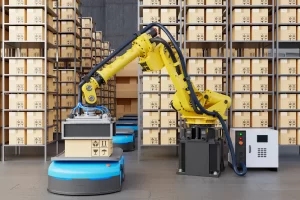
In high-throughput warehouses, robotic uptime has become as critical as inventory accuracy. Yet one of the smallest components, the robotic gripper, remains a frequent source of failure. Over time, suction pads lose pressure, fingers misalign, and joints wear unevenly, leading to mispicks that quietly erode throughput and quality metrics.
A new generation of vision-based predictive maintenance systems is tackling that problem head-on. By analyzing images, pressure readings, and torque data in real time, predictive systems can spot fatigue or imbalance before failure occurs. The result is not just fewer breakdowns, but steadier throughput and higher order accuracy.
As logistics networks race to automate under tighter margins, these self-diagnosing grippers offer a glimpse of what reliability will look like in the next generation of smart warehouses, where machines don’t just work harder, but know when they’re about to fail.
The Hidden Cost of Gripper Fatigue
Robotic pickers handle thousands of units per shift across categories ranging from fragile consumer goods to irregular industrial components. Even minor deviations, a loose seal on a suction cup or a millimeter drift in grip alignment, can multiply into hundreds of mispicks daily.
Traditional maintenance relies on static service intervals or reactive repairs after breakdowns. But those schedules rarely account for variable workloads, environmental factors, or the different lifespans of gripper materials. A robot operating in a cold chain or handling corrugated boxes wears down differently than one working in ambient environments with smooth cartons.
In a robotics system at Volkswagen’s vehicle assembly facility in Poland, engineers deployed a fault-detection system (RSIMS) that identified leaks in the pneumatic lines and degradation in the gripper’s valve island, issues otherwise invisible until a failure. The system flagged increased gripper closing times (from about 3 seconds longer) and air leaks that would otherwise have forced emergency stops. These small degradations in the gripper subsystem directly impacted throughput and triggered downtime events.
Each stoppage not only halts operations but demands manual intervention, safety checks, and system resynchronization, causing ripple effects throughout the fulfillment and assembly line.
How Predictive Gripper Maintenance Works
AI-enabled vision models continuously monitor gripper performance through embedded cameras and sensors that capture contact pressure, suction stability, and minute surface changes. The system learns the “normal” operating signature of each end effector and flags deviations in real time.
1. Image-Based Wear Detection: High-resolution cameras now serve as a robot’s eyes for preventive maintenance. Mounted near the gripper head, these cameras continuously capture close-range imagery of contact points, seals, and joint housings. Computer vision models compare these images against known baselines to detect micro-cracks, seal deformations, or subtle discoloration patterns that signal material stress long before failure. By learning from thousands of historical wear profiles, the AI can calculate the remaining useful life of each component, triggering a maintenance flag when surface irregularities begin to cross functional thresholds. This eliminates guesswork and transforms what was once an end-of-shift inspection into a live, automated quality check.
2. Force and Torque Sensing: Integrated pressure and torque sensors embedded in the gripper’s joints capture how force is distributed across each pick. A consistent shift in pressure or torque asymmetry may indicate mechanical fatigue, uneven load distribution, or lubrication loss, early warning signs that manual observation would miss. In modern systems, these readings are analyzed in real time and benchmarked against both historical norms and manufacturer tolerances. When pressure consistency drops below a set variance, the system can recommend recalibration or component replacement before slippage or misalignment compromises order accuracy.
3. Predictive Scheduling: Once anomalies are detected, the system automatically adjusts the maintenance plan inside the Warehouse Execution System (WES). Rather than following static, calendar-based intervals, maintenance windows become dynamically scheduled based on the data’s urgency and operational load. If a gripper shows signs of wear but remains within safe limits, its service can be delayed until a low-volume shift. Conversely, if torque readings spike beyond safe margins, the WES can reprioritize that robot for immediate intervention, minimizing downtime while avoiding unnecessary stoppages. This data-driven scheduling aligns maintenance effort with actual risk rather than arbitrary cycles.
4. Cloud-Linked Learning: At the enterprise level, predictive gripper maintenance becomes exponentially smarter when connected across sites. Cloud-based AI platforms aggregate performance data from hundreds of robots operating in different climates, workloads, and product categories. This shared learning refines failure models, improving predictive accuracy and allowing organizations to benchmark supplier components, material quality, and usage environments. For global logistics networks, this fleet-level intelligence enables standardization of maintenance practices and procurement criteria, turning a traditionally reactive, site-specific process into a scalable reliability framework powered by collective insight.
This closed-loop process transforms grippers from consumable tools into continuously monitored assets, extending usable life while maintaining precision.
Securing the Next Production Model
JLR’s rebound may signal a return to output, but it also highlights how manufacturing resilience now hinges as much on digital recovery protocols as on physical capacity. As more automakers integrate AI-driven production planning and connected machinery, cyber risk is becoming a core element of operational design. Firms that embed real-time threat monitoring directly into factory control systems are setting a new benchmark for what operational continuity looks like in a digitized industry.