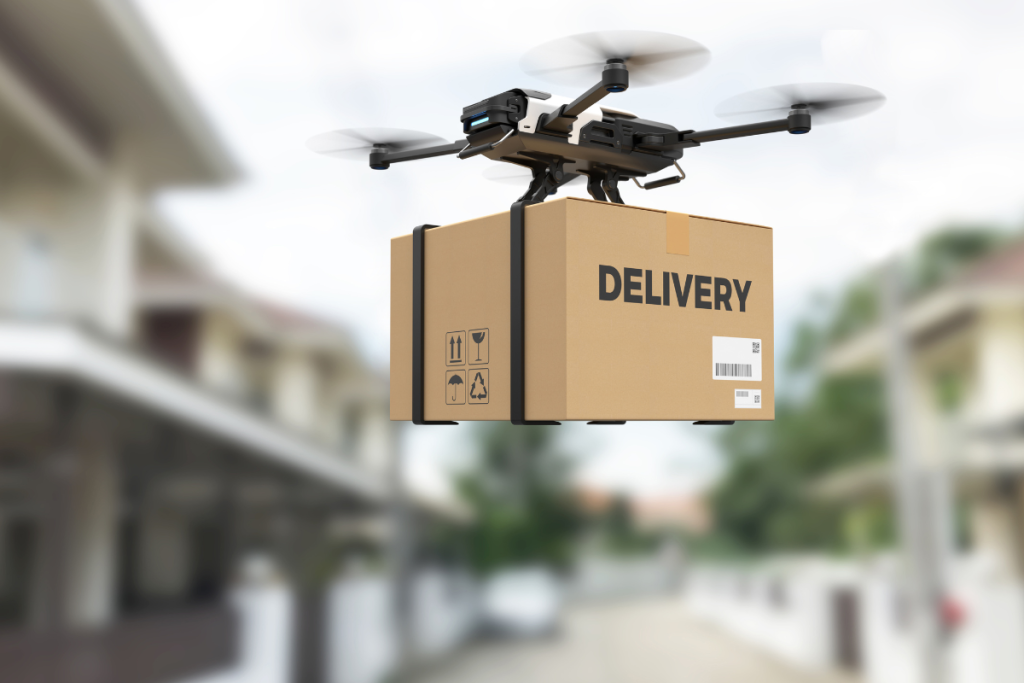
Fifteen-minute delivery was once the domain of scooters and bike couriers. But the economics of urban logistics are shifting again as retailers, mall operators, and property developers begin embedding drone hubs directly into rooftops, parking decks, and high-rise complexes. These hyperlocal air nodes promise to move high-value, lightweight goods, groceries, pharmaceuticals, and electronics, within a 3- to 5-kilometer radius in minutes, bypassing ground congestion and cutting labor costs.
The race is no longer just about speed. It’s about building the infrastructure that lets drones operate as predictably as delivery vans, with repeatable flight paths, real-time visibility, and shared regulatory frameworks.
From Rooftops to Retail Corridors
Quick-commerce networks exploded during the pandemic, fueled by dense micro-warehouses and aggressive promotions. But road congestion, rising courier costs, and zoning limits have exposed the limits of ground-based speed. Hyperlocal drone nodes aim to fill that gap by turning existing vertical assets, shopping centers, office roofs, and mixed-use towers, into distributed launch pads.
Amazon’s push into sub-15-minute grocery delivery in India offers a glimpse of the next phase. The company is piloting the model in select cities, aiming to serve every postal code with what it calls “the largest selection at fastest speeds.” Cities across Asia and the Middle East are preparing for the aerial layer of that same model. Dubai, Singapore, and Seoul are mapping “drone highways” linking hospitals, malls, and fulfillment centers, while U.S. pilots in Texas and Florida, including Walmart’s partnership with Wing, use retail rooftops as drone bays for on-demand grocery and pharmacy runs.
Retailers see these nodes as a new form of last-100-meter fulfillment, connecting directly to micro-DCs or store inventory. A single rooftop air node can support hundreds of daily flights carrying medicines, electronics, or prepared meals, drastically shortening delivery cycles for high-frequency categories.
The Air Node Infrastructure Stack
To make 15-minute drone logistics viable, operators are layering multiple systems across each site:
Vertiport Integration: The backbone of hyperlocal drone logistics is the modular vertiport—compact landing decks that integrate automated charging, cooling, and loading systems. Each unit functions like a pit stop, allowing drones to land, recharge, swap payloads, and relaunch within minutes. Advanced docking arms and robotic loaders eliminate manual intervention, ensuring continuous rotation throughout the day. These decks are designed for flexible installation on rooftops, parking structures, or mall annexes, making it possible to scale operations rapidly across dense urban grids.
Digital Air Traffic Control: Unlike traditional aviation, urban drone traffic requires high-frequency coordination across low-altitude corridors. AI-driven air traffic systems now manage these networks, sequencing takeoffs and landings while maintaining safe vertical and horizontal separation. Integrated weather sensors and predictive analytics reroute drones in real time to avoid turbulence, signal interference, or temporary no-fly zones. The result is an invisible but highly orchestrated aerial layer that mirrors the precision of airport control towers, only compressed into a city block.
Payload Standardization: To make drone logistics commercially viable, cargo handling must be standardized. Operators are adopting lightweight, thermally insulated containers equipped with smart locks, temperature sensors, and GPS tags. These payload modules fit seamlessly into different drone models and are tracked from dispatch to delivery through encrypted cloud links. For retailers, this standardization means confidence in the integrity of sensitive shipments, whether pharmaceuticals, groceries, or small electronics, while simplifying regulatory compliance for temperature or tamper control.
Urban Energy Links: Sustainability and uptime converge at the rooftop. Solar panels and battery banks installed alongside vertiports provide a self-sustaining energy loop, allowing continuous drone charging without drawing heavily on the urban grid. In peak demand periods or outages, these systems function as microgrids, ensuring that aerial delivery remains uninterrupted. Some developers are even integrating dynamic load management, adjusting charging rates based on available sunlight or local grid pricing, a step toward truly energy-aware logistics infrastructure.
Retail Co-Location: The final layer connects air nodes directly into retail and warehouse inventory systems. APIs link drones to point-of-sale and fulfillment platforms, enabling real-time item picking and dispatch, what operators call “click-to-lift.” A grocery order placed online triggers immediate product selection, container packing, and drone deployment, often within five minutes. Co-locating vertiports at malls or store rooftops transforms them into fulfillment satellites, turning retail real estate into active nodes within the broader last-mile network.
This architecture reduces both delivery time and the ground footprint needed for traditional fleets, offering scalability without adding traffic to already constrained roads.
Rooftops as the Next Supply Chain Frontier
The rise of drone-enabled air nodes is less about speed than about network design. As rooftops evolve into micro-fulfillment assets, logistics is intersecting with urban planning, energy management, and property development in ways few regulatory systems were built to handle. The companies moving earliest to formalize these cross-sector partnerships, between retailers, real estate owners, and city authorities, will shape how aerial logistics integrates into the urban economy, not just how quickly it delivers.