Amazon’s Q3 results mark a decisive structural realignment, synchronising its physical logistics network and digital infrastructure into a single, AI-orchestrated operating system built for speed, resilience, and scale.
Key Takeaways:
From Network to Nervous System
Amazon’s latest quarter signals a fundamental break from the logistics model that defined its first two decades. What began as a vast fulfilment footprint is evolving into a self-adjusting operating network where physical and digital flows operate in parallel. The decision to regionalise fulfilment, accelerate automation, and build hyperscale infrastructure under a unified AI logic reflects a deliberate move from expansion to orchestration.
Operationally, the company has restructured its U.S. network around proximity and algorithmic precision. The shift reduced inbound lead times by nearly four days year-on-year and positioned inventory closer to demand. Same-day delivery for perishables, a service now available in more than 1,000 cities, is being scaled to 2,300 by year-end, turning fresh groceries into a throughput driver for the broader network.
This redesign marks Amazon’s transition from warehouse-centric logistics to a regionalised model similar to what FedEx and UPS have pursued through their own consolidation programs. Where FedEx halved handoffs under its DRIVE initiative and UPS automated 45% of its sortation volume, Amazon’s end-to-end redesign now integrates placement algorithms, AI route selection, and robotics as part of a single operating layer.
Engineering Speed at Scale
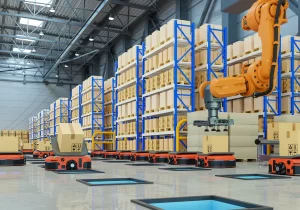
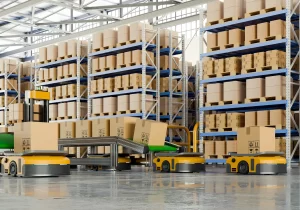
The operational mechanism behind Amazon’s acceleration lies in concurrent investments in automation and AI-led orchestration. Over one million robots now operate across its fulfilment centres, performing storage, sortation, and packing functions once limited by manual cadence. The system operates as a co-engineered environment where robotics handle repetitive precision and human teams focus on problem resolution and real-time exception management.
To sustain the speed of execution, Amazon has invested over $4 billion to extend its rural delivery network, reaching 60% more small-town communities where competitors have reduced service. The intent is structural: to achieve geographic completeness rather than incremental reach. This creates a differentiated coverage map, particularly as Target’s hybrid store fulfilment now serves 60% of orders and Home Depot’s market delivery operations reach 90% of the U.S. population. Amazon’s rural expansion fills the remaining whitespace.
In practice, operationalising such a network requires a redesigned demand-sensing system that governs inventory deployment in near real time. Algorithmic models optimise placement across regional nodes to minimise distance travelled per package, while inbound scheduling has been shortened through tighter supplier integration and dynamic slotting. These changes translate directly into lower working capital and margin resilience, an uncommon feat in a year marked by logistics inflation.
The Infrastructure Layer Behind It
The same orchestration logic is visible upstream in Amazon Web Services. AWS added 3.8 gigawatts of power capacity in the past year, doubling its 2022 level and targeting another doubling by 2027. This expansion is not only about data-centre throughput but about supply chain design for compute: synchronising power, chips, and location to ensure continuous scaling for AI workloads.
AWS’s capacity strategy mirrors industrial supply planning, securing long-lead assets such as semiconductors from multiple partners, NVIDIA, AMD, and Intel, while vertically integrating its own Trainium processors. Trainium2’s 150% quarter-on-quarter revenue growth and full subscription demonstrate both demand velocity and the maturity of Amazon’s internal chip manufacturing chain. With Trainium3 scheduled for 2026, AWS is running a parallel capacity race with Microsoft Azure, which reported 2.5 gigawatts of incremental build-out and three semiconductor partners this year.
In operational terms, the build-out functions like a global supply chain for compute resources, balancing procurement diversification, regional siting, and infrastructure redundancy. It transforms AWS from a cloud platform into a supply platform: one where silicon, power, and resilience are governed as interdependent flows.
Constraints and Consequences
The gains in speed and automation come with systemic pressures. AWS’s capital intensity, $34 billion in Q3 and an estimated $125 billion for 2025, imposes a longer payback horizon than traditional logistics investment. Fulfilment automation also introduces complexity in system governance: robotics fleets, predictive inventory models, and AI decision layers require disciplined data integrity and maintenance cycles to avoid throughput disruption.
Moreover, as Amazon extends its network into rural markets and perishables, last-mile cost-to-serve risks rising faster than volume growth. Balancing that equation will depend on sustained utilisation of regional assets and algorithmic optimisation, an area still maturing across the sector.
Redefining the Supply Chain Playbook
Amazon’s transformation illustrates a broader redefinition of supply chain logic in 2025. Where peers like Walmart and UPS are achieving 40–65% automation within discrete domains, Amazon is applying the same precision across both its physical and digital networks simultaneously. The structural implication is that fulfilment, compute, and data infrastructure are no longer separate capabilities but elements of one orchestrated system.
In this integrated model, fulfilment nodes act as the physical edge of a much larger AI-driven network, while AWS provides the computational backbone that enables predictive placement, dynamic routing, and capacity allocation. The result is a feedback loop between digital and physical assets, one that compresses time, lowers working capital, and raises the bar for resilience. Amazon’s model is not without friction, but it sets a new operational benchmark: the supply chain as an intelligent, continuously optimising organism. For enterprise leaders across sectors, it reframes the challenge from scaling capacity to synchronising it, a shift that may define the competitive architecture of the decade ahead.