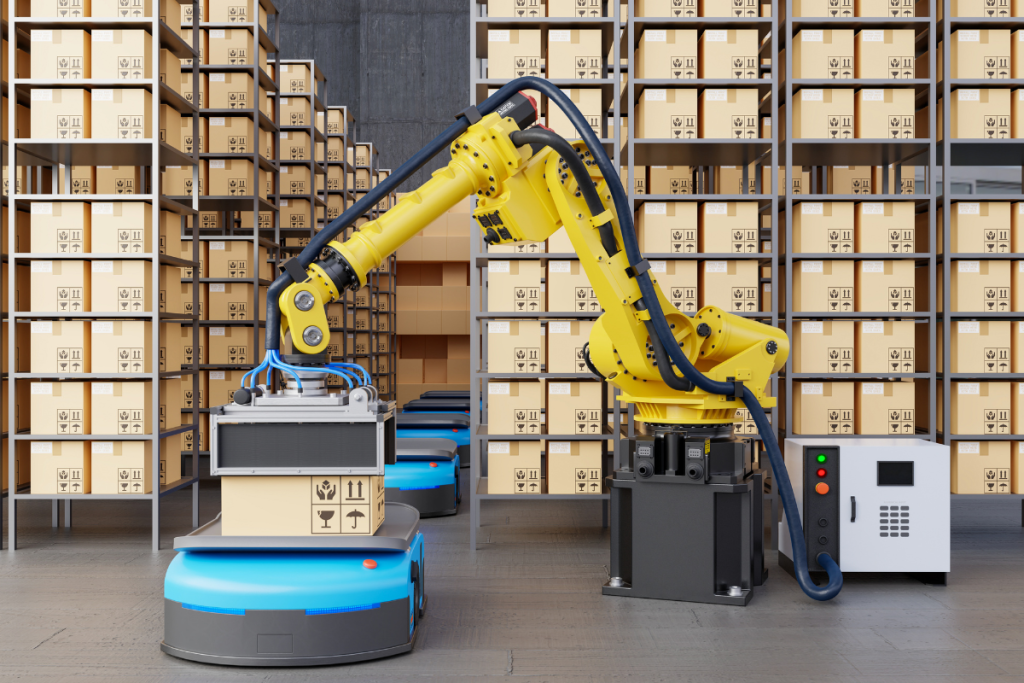
Robots are taking on more of the heavy lifting inside warehouses, moving parcels and pallets at speeds no human crew could match. But as fleets grow, so do the risks. A single fault in navigation or a software update gone wrong can snarl dozens of machines at once, halting operations that depend on split-second coordination.
To guard against these cascading breakdowns, operators are building new safety nets that watch the entire system rather than individual units. Instead of reacting to accidents after they happen, these safeguards slow down or isolate parts of the fleet at the first sign of trouble, aiming to keep goods moving and downtime contained.
When One Failure Becomes Many
Traditional safety measures focus on individual units: collision sensors, emergency stop buttons, or local overrides. But as fleets grow into the hundreds, failures rarely stay isolated. A broken conveyor feeding an AMR cluster, a corrupted software patch, or a misaligned vision system can ripple instantly through a network of robots.
A widely shared incident at an Amazon facility showed two warehouse robots stuck in a mirrored loop, endlessly retracing each other’s paths. What looked like a trivial glitch highlighted how navigation faults can quickly escalate when mirrored across multiple machines, risking broader congestion in high-volume hubs.
Recent incidents in parcel hubs have shown how small defects escalate. A misplaced pallet can send multiple AMRs into looped detours, clogging aisles. In cold chain facilities, a single sensor misread can strand refrigerated loads if the entire fleet reroutes incorrectly. Without systemic safeguards, operators are left reacting manually, slowing recovery and raising safety exposure.
Building the Robotic Safety Net Stack
Fleet-Level Monitoring: Instead of treating each robot as a self-contained unit, fleet monitoring aggregates telemetry from every AMR across the warehouse. Speed, trajectory, error codes, and even battery status are streamed into a central dashboard. This continuous oversight allows operators and AI systems to identify subtle shifts, such as a group of robots slowing in the same zone, that may indicate an emerging system-wide fault rather than isolated glitches.
Anomaly Detection Engines: Machine learning models trained on historical performance data scan for patterns that deviate from normal operations. These engines are not just looking for obvious breakdowns but for recurring outliers, such as navigation errors that occur in synchrony across multiple units or repeated stoppages in the same aisle. The goal is to spot early signals of instability before they escalate into facility-wide congestion.
Cascading Risk Logic: When an anomaly is detected, the system runs simulations to assess whether the issue is likely to spread. For example, a conveyor belt jam may only affect one zone, while a corrupted software patch could trigger navigation errors across the fleet. By projecting potential chain reactions, cascading risk logic allows the platform to decide whether local intervention is enough, or whether broader safeguards must activate immediately.
Emergency Slowdowns: Rather than stopping all robots outright, which could paralyze throughput, orchestration software can dial down speed in affected areas. This creates a controlled slowdown that reduces collision risks while still allowing some movement of goods. The slowdown buys valuable time for technicians to investigate and prevents the kind of all-or-nothing stoppage that can disrupt customer commitments.
Zone-Based Isolation: If a problem is concentrated in one section, say, a misaligned vision sensor in a high-density picking zone, the system can lock down that aisle while rerouting unaffected fleets elsewhere. This form of containment keeps the rest of the operation running while technicians resolve the localized failure. By isolating trouble spots, facilities preserve overall flow rather than resorting to full-facility shutdowns.
Audit Trails: Every slowdown, reroute, or isolation event is automatically documented in compliance-ready records. These audit trails are essential not only for internal safety reviews but also for external stakeholders such as regulators and insurers. Detailed logs demonstrate due diligence in risk management, strengthen claims in the event of disruption, and provide valuable feedback for continuous improvement of safety protocols.
Trials in high-density parcel hubs have shown that collaborative safety nets can cut downtime from cascading failures by more than 40%. The value is not just uptime but predictability: operators gain a structured response instead of relying on human judgment under pressure.
Resilience Beyond the Warehouse Walls
The real test of these safety nets may not come from inside the facility but from the pressures surrounding it. Peak-season surges, volatile labor markets, and unpredictable trade disruptions mean warehouses are running closer to their limits than ever before. In that context, robotic safeguards become more than an engineering solution, they are a form of operational insurance. Treating them as part of a broader resilience strategy, alongside contingency labor pools and diversified carrier contracts, could determine which networks recover quickly when the next disruption hits.