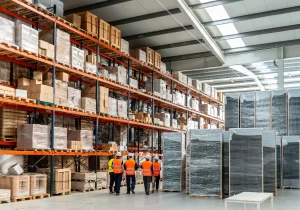
The modern warehouse is under sustained pressure to do more with less space. Higher order volumes, tighter delivery windows, and rising labor costs have pushed operators to pack more people, forklifts, and autonomous mobile robots into the same footprints. That density is delivering productivity gains, but it is also exposing the limits of traditional safety approaches that were designed for slower, more predictable environments.
Safeguarding is no longer about addressing isolated hazards. It is about managing continuous, fast-moving interactions across mixed fleets of humans and machines. Increasingly, that requires systems that understand space, motion, and context in real time. Spatial AI is emerging as a practical way to shift safety from a reactive compliance function to an operational capability that supports uptime and flow.
Why Conventional Collision Avoidance Breaks Down
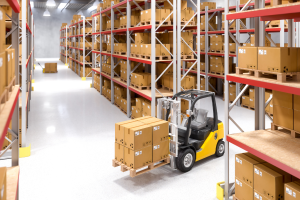
Incidents involving material handling equipment remain one of the most persistent safety risks in warehouses, despite decades of investment in alarms, barriers, and procedural controls. Many facilities rely on basic anti-collision technologies, ultrasonic sensors, proximity beacons, or simple LiDAR, to alert drivers to nearby obstacles. These tools detect presence, but not intent.
The result is a high volume of false alerts. Drivers are warned when passing a pedestrian on a protected walkway or moving alongside a stationary object that poses no real threat. Over time, these constant interruptions erode trust in the system. Alerts are ignored, muted, or switched off entirely, undermining the very safeguards they were meant to provide.
Adding more sensors does not solve this problem. Without contextual awareness, what the object is, how fast it is moving, and whether paths are converging, systems cannot distinguish between risk and routine activity. Safety becomes noisy instead of precise.
Spatial AI and Contextual Awareness on the Warehouse Floor
Spatial AI addresses this gap by continuously answering two foundational questions: where am I, and what is around me? Using intelligent cameras and onboard processing, spatial systems build a live understanding of position, movement, and surroundings in three dimensions.
This capability underpins advanced real-time locating systems, enabling assets to be tracked with far greater accuracy and relevance. A forklift is no longer just “near” something; it is approaching a pedestrian at a specific speed and angle, or moving safely past a robot on a parallel route. Alerts are triggered only when trajectories indicate genuine danger.
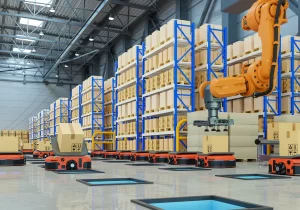
The impact is particularly significant in mixed-fleet environments. Manual forklifts equipped with spatial awareness effectively become connected assets, sharing location, speed, and direction data with autonomous mobile robots. Robots can then anticipate human-driven vehicles approaching blind corners or congested intersections and adjust routes dynamically, reducing close encounters before they occur.
This awareness also improves traffic flow. When robots understand manual vehicle patterns, they are less likely to block aisles or hesitate unnecessarily. That reduces driver frustration, a known contributor to unsafe behaviors such as risky overtakes or sudden maneuvers.
Spatial data also feeds into digital twin models, allowing facilities to simulate safety scenarios before making physical changes. New robot routes, revised intersection layouts, or workflow adjustments can be tested virtually to identify unintended risks. According to trade reports, this form of pre-deployment validation is increasingly used to balance throughput improvements with safeguarding requirements, especially in high-density sites.
When Fewer Alerts Make Operations Safer
One of the most overlooked risks in warehouse safety is cognitive overload. Excessive warnings create distraction and complacency, dulling attention rather than sharpening it. Spatial AI reduces this noise by ensuring alerts are rare, relevant, and credible. When drivers know that an alarm signals a real hazard, response times improve and safe behaviors are reinforced.
As automation accelerates, the facilities that perform best will not be those with the most sensors, but those with the clearest understanding of how people and machines share space. Spatial intelligence offers a way to protect that balance, supporting higher density and speed without accepting higher risk.