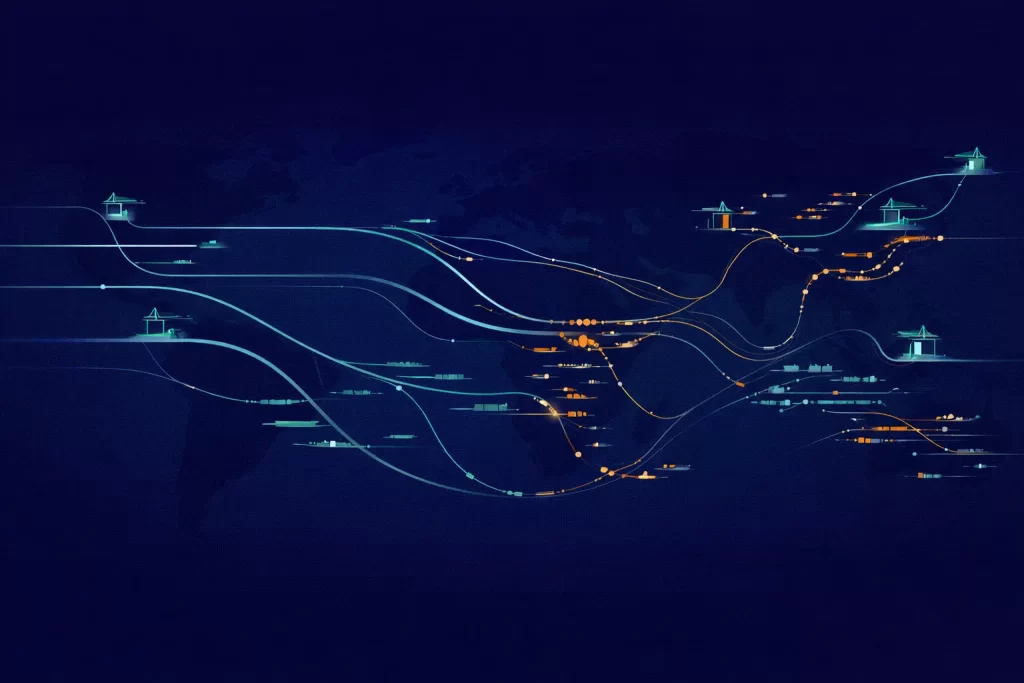
Ports are no longer behaving as a uniform system. Delays, turnaround times, and emissions profiles are diverging across regions and vessel classes, reshaping how reliability is measured. The shift is forcing freight networks to operate against a moving set of conditions rather than a stable global baseline.
Fragmentation Is Replacing Global Benchmarks
Port efficiency is diverging at a level that challenges long-standing assumptions about consistency across major trade lanes. According to a 2025 analysis by VesselBot, anchorage times, port call duration, and emissions exposure are no longer aligned across geographies or time periods, creating uneven operating conditions for carriers and shippers.
On average, vessels spent about seven hours at anchorage per port call in 2025. That headline figure masks wide dispersion: delays ranged from 6.2 hours in July to 8.4 hours in December, reflecting seasonal congestion patterns, while regional differences were even more pronounced. Northern Europe recorded average anchorage times of 5.7 hours, compared with 10.5 hours in the Mediterranean, highlighting how localized constraints are reshaping transit reliability.
Year-over-year shifts reinforce this trend. Anchorage times rose sharply in the fourth quarter, increasing 32.9% in the Mediterranean and 39% in Northern Europe. By contrast, the U.S. West Coast stood out as the only major region to post measurable efficiency gains, suggesting that targeted operational adjustments, such as berth scheduling improvements and labor stabilization, can still deliver performance gains even in a volatile environment.
This divergence is being driven by overlapping disruptions. Extreme weather events, labor disruptions, and geopolitical tensions are no longer episodic shocks; they are occurring frequently enough to create persistent regional imbalances in port throughput and turnaround times.
Vessel Size Is Creating Structurally Different Port Dynamics
The widening performance gap is also being shaped by vessel segmentation. Smaller feeder vessels and large container ships now operate under fundamentally different port conditions, with distinct cost, time, and emissions profiles.
Feeder vessels averaged 7.7 hours at anchorage and 16.4 hours at berth per call, reflecting higher wait times but shorter handling cycles. In contrast, very large container ships spent just 3.9 hours at anchorage but remained at berth for an average of 34.2 hours. As vessel size increases, time shifts from waiting to processing, altering how congestion manifests across the network.
These structural differences carry financial and environmental consequences. Total port call emissions exceeded 12 million tons of CO₂e in 2025, with 22% generated during anchorage and 78% at berth. The distribution underscores how inefficiencies are embedded not just in delays but in how vessels are handled once alongside.
According to trade reports and port authority data, the continued upsizing of vessels, driven by economies of scale, has outpaced infrastructure upgrades in several regions. This mismatch is contributing to longer berth times and operational bottlenecks, particularly in ports that lack sufficient crane capacity or yard automation to handle ultra-large ships efficiently.
Planning Cycles Are Colliding With Real-Time Volatility
The growing dispersion in port performance is exposing a gap between traditional planning cycles and current operating conditions. Routing, scheduling, and cost models built on historical averages are increasingly misaligned with day-to-day variability.
This is where real-time visibility is becoming critical. As Constantine Komodromos, CEO of VesselBot, notes, relying on quarterly or annual benchmarks risks locking decisions into outdated assumptions. Live data on port congestion, vessel queues, and turnaround times allows logistics teams to adjust routing, re-sequence shipments, and deploy contingency options before delays cascade through the network.
Recent data from maritime analytics platforms and AIS tracking systems shows that carriers are already shifting toward more dynamic planning models, using predictive signals to anticipate congestion rather than react to it. This shift is gradually changing how reliability is defined, not as adherence to a fixed schedule, but as the ability to adapt in transit.